
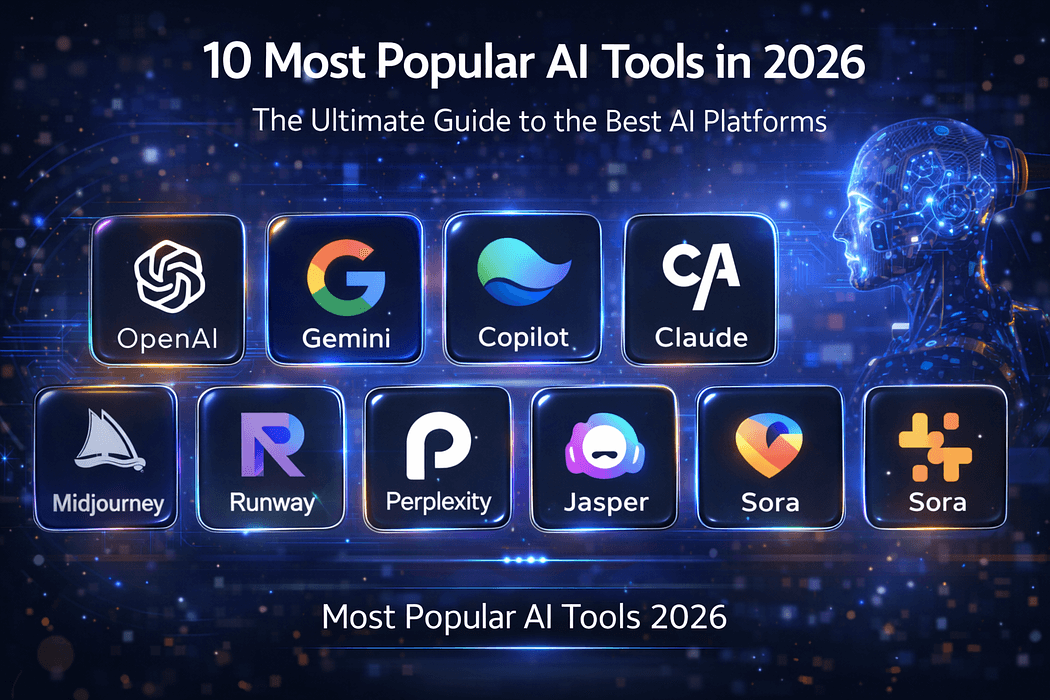
Here is a number worth sitting with: over one billion people now use standalone AI tools every single month. Not occasionally. Every month. According to DataReportal's Digital 2026 report, we have crossed that threshold, and the growth is still accelerating. More than 75 percent of workers report using generative AI in their daily tasks, and the average professional is now juggling three to five AI tools at once. So if you have been trying to figure out which tools are actually worth your time in 2026, you are asking exactly the right question. Here are the ten most popular AI tools right now, what they actually do, and who should be using them.
ChatGPT is still the biggest name in AI tools, full stop. OpenAI's flagship platform crossed 750 million weekly active users by September 2025 according to a study published in partnership with the National Bureau of Economic Research, and its website receives over 5.4 billion monthly visits, making it the fifth most visited site on the internet. That is not a niche product anymore. That is infrastructure.
What makes ChatGPT the go-to starting point for most people is its sheer breadth. Writing, coding, brainstorming, image generation, voice mode, web search, document analysis, and now video generation through Sora are all available in a single interface. The free tier is generous enough to be genuinely useful, and the Plus plan at 20 dollars per month unlocks GPT-5 and priority access. For anyone new to AI tools for productivity, this is where to start.
Google Gemini is ChatGPT's closest rival in the general-purpose AI assistant category and the fastest-growing challenger to its market share in 2026. Its core advantage is Google's ecosystem: Gemini integrates directly with Gmail, Google Docs, Google Drive, YouTube, and Google Search in ways that no other tool can replicate. If your work and personal life run through Google's apps, Gemini is not just another chatbot. It is an assistant with direct access to your actual files, emails, and calendar.
Gemini 2.5 Pro, available on the paid tier, has topped multiple reasoning and coding benchmarks in early 2026. Its native multimodal capability handles text, images, audio, and video in a single conversation. For content creators and marketers who rely heavily on Google's suite of tools, Gemini is the AI tools for content creation choice that fits most naturally into an existing workflow without requiring any new software setup.
Claude, made by Anthropic, has carved out a distinct and loyal following among professionals who need precision over personality. Its reputation in 2026 is built on three things: exceptional performance on long-context tasks, accurate and nuanced instruction-following, and a writing quality that consistently outperforms competitors on complex structured documents. If you are analyzing a 200-page contract, writing technical documentation, or debugging complex code, Claude is the tool professionals reach for first.
Claude Code, its agentic coding tool launched in May 2025, has already become the number one AI coding tool among software engineers according to the Pragmatic Engineer's 2026 survey, ahead of GitHub Copilot and Cursor in just eight months. The free tier is available at claude.ai, with Pro at 20 dollars per month and the Max plan at 100 dollars per month for power users and developers who need maximum capacity.
Perplexity is the AI tool that is quietly replacing Google Search for millions of users who want answers, not links. It delivers sourced, cited responses to research questions in seconds, pulling from live web results and presenting a synthesized answer with references you can verify. Think of it as a researcher who reads everything relevant to your question and summarizes it for you rather than handing you a pile of blue hyperlinks.
Perplexity is one of the fastest-growing AI tools for business in 2026, particularly popular with professionals who do a lot of market research, competitive analysis, and fact-checking. Its Pro Search mode handles multi-step research queries that would previously require opening 10 different browser tabs. The free tier covers most casual use, and Pro is 20 dollars per month.
Cursor is an AI-native code editor that has fundamentally changed how many developers write software, and it is one of the most talked-about latest AI tools 2026 in the developer community. Built on top of VS Code, it understands your entire codebase, not just the file you have open, and uses that context to suggest completions, refactor functions, explain errors, and write new features based on natural language descriptions.
Over 56 percent of engineers now report doing 70 percent or more of their coding work with AI assistance, according to the Pragmatic Engineer's 2026 survey, and Cursor is a major reason why. It is the strongest choice for developers who want AI assistance embedded directly in their development environment rather than in a separate chat window. The free tier covers basics, and the Pro plan is 20 dollars per month.
Microsoft Copilot is the AI tools for automation choice for the hundreds of millions of people already working in Microsoft 365. Embedded across Word, Excel, PowerPoint, Teams, and Outlook, it turns natural language instructions into completed work: draft this email, summarize this meeting, analyze this spreadsheet, build this presentation. The free Copilot Chat tier is now included with Microsoft 365 subscriptions, and 88 percent of organizations are already using AI regularly in their operations.
The real power of Copilot is its organizational memory: it grounds responses in your actual emails, documents, meeting recordings, and SharePoint content rather than general knowledge. Agent Mode, rolled out in November 2025, takes it further by executing multi-step tasks autonomously. For corporate teams that live in Microsoft's ecosystem, this is not a nice-to-have anymore. It is the AI tool that is already in your license.
Grok, built by Elon Musk's xAI and deeply integrated into the X platform, has established itself as the AI tool of choice for people who want real-time information, fewer content restrictions, and direct access to what is trending right now. Its live web access and direct integration with X's data stream makes it uniquely valuable for tracking breaking news, monitoring social media trends, and getting instant context on fast-moving events.
Grok 3, released in February 2025, delivered significant improvements in reasoning and coding that made it competitive with the top general-purpose models for the first time. It is particularly popular with journalists, social media managers, marketers, and anyone who needs AI tools that are genuinely plugged into what is happening in the world right now rather than trained data with a cutoff date.
ElevenLabs has become the undisputed leader in AI voice generation and audio AI, and it is one of the fastest-growing AI tools for creators in 2026. It generates hyper-realistic text-to-speech in over 30 languages, clones voices from a short audio sample, and produces audio that is genuinely difficult to distinguish from professional studio recordings. Podcasters, video creators, e-learning developers, and localization teams all rely on it.
The practical use case that has driven most of its growth is dubbing and localization: create a video once in English and use ElevenLabs to produce versions in Spanish, French, German, Japanese, and Mandarin with voice clones that sound like the original speaker. For content creators and businesses with global audiences, this capability removes a production bottleneck that previously required hiring voice actors in multiple languages.
Zapier is the AI tools for automation choice that does not require you to write a single line of code. It connects over 7,000 apps and uses AI to build multi-step automated workflows, called Zaps, based on plain English descriptions of what you want to happen. Tell it to automatically save email attachments to Google Drive, add new form submissions to a CRM, and send a Slack notification, and it builds that workflow for you.
Zapier's AI agents, launched in 2025, go further by handling multi-step decision-making within workflows rather than just linear triggers and actions. For small business owners, solopreneurs, and non-technical teams, Zapier is the tool that makes AI-powered automation genuinely accessible. Its free tier supports basic automations, with paid plans starting at around 20 dollars per month.
NotebookLM, Google's research and study assistant, has developed one of the most unexpectedly enthusiastic user bases of any AI tool in 2026. You upload your own documents, PDFs, research papers, or notes, and NotebookLM becomes an expert on exactly that content. It answers questions, generates summaries, identifies connections between ideas, and, in its most viral feature, converts your documents into podcast-style audio conversations between two AI hosts.
It is genuinely free, which makes it one of the highest-value AI tools for productivity available at any price. Students, researchers, consultants, and anyone who needs to quickly get across a large volume of written material use it as a personal knowledge assistant. If you have a stack of documents you need to understand deeply and fast, NotebookLM is the fastest path from a pile of PDFs to a working knowledge of what is in them.
Here is the honest advice: do not try to use all ten at once. Surveys show that 60 percent of professionals now use three or more AI tools daily, but the most effective users are not the ones with the most tools. They are the ones who have matched the right tool to the right job. Start with the tool that addresses your biggest daily time sink: writing, research, coding, automation, or voice creation.
Start on free tiers before upgrading. The free versions of ChatGPT, Gemini, Claude, Perplexity, NotebookLM, and Zapier are all genuinely capable. Spend two weeks on the free tier of one tool and identify where it saves you the most time before paying for anything. The tools that deliver real ROI make themselves obvious quickly.
The most popular AI tools in 2026 are not science fiction anymore. They are practical, accessible, and in many cases free. ChatGPT and Gemini for general-purpose assistance. Claude for precision writing and coding. Perplexity for research. Cursor for developers. Microsoft Copilot for enterprise teams. Grok for real-time information. ElevenLabs for voice and audio. Zapier for automation. NotebookLM for deep document understanding. Together, these tools cover almost every professional and personal productivity use case imaginable.
The AI adoption gap between people using these tools and those who are not is widening fast. That is not a reason to feel overwhelmed. It is a reason to pick one tool from this list today, try it on a real task you do every week, and see what happens. One hour of genuine experimentation will tell you more about which AI tools belong in your workflow than any amount of reading about them.