
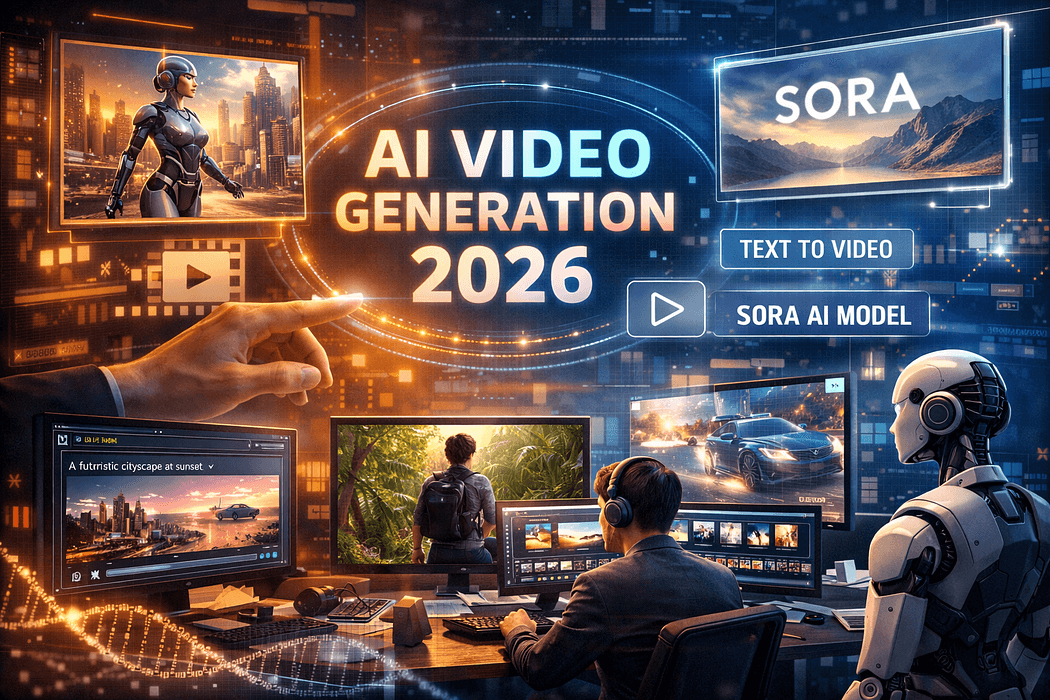
The way video content is made has shifted dramatically. What once required camera crews, editing suites, and weeks of post-production can now be initiated with a text prompt and completed in minutes. AI video generation in 2026 has reached a level of maturity that is reshaping creative industries, marketing pipelines, and educational content at scale. For anyone working in digital content — whether independently or within an organization — understanding this landscape is no longer optional.
The concept of generating video from text or images is not new, but the leap in quality between 2023 models and today's systems is significant. Early tools produced short, stuttering clips with warped physics and inconsistent subjects. Current models produce coherent, stylistically rich video sequences that hold lighting consistency, maintain subject identity across frames, and respond to nuanced prompts with surprising accuracy.
This improvement is driven by several converging developments: vastly larger training datasets, diffusion-based video architectures, and improved temporal coherence — the ability of a model to maintain logical continuity between frames over time. The practical result is that AI-generated video now passes basic visual scrutiny in a wider range of applications than it did even eighteen months ago.
Sora, OpenAI's text-to-video model, remains one of the most discussed tools in this space. Released more broadly through 2025 and continuing to evolve in 2026, Sora accepts text descriptions and generates video clips of up to several minutes in length. It can also extend existing video, fill in missing frames, or animate still images.
What distinguishes Sora from earlier models is its understanding of physical plausibility. It does not simply generate visually appealing images in sequence — it attempts to model how objects and environments behave over time. A prompt describing a paper boat floating down a rain-filled street will produce motion that accounts for water flow, drift, and the weight of the object, rather than simply sliding the boat laterally across a static background.
Sora is most effective for cinematic and narrative content — establishing shots, visual storytelling sequences, and prototype video concepts. It is less suited to precise real-world footage where accuracy and factual specificity are required, such as product demonstrations or news-style reporting.
Sora does not operate alone. A competitive ecosystem of AI video generation tools has matured alongside it, each with its own strengths and intended use cases.
Runway Gen-3 Alpha has established a strong position in the professional creative space, offering frame-by-frame control, camera motion prompting, and tighter integration with existing video editing workflows. Kling, developed by Chinese AI company Kuaishou, demonstrated that non-Western developers could achieve comparable quality with particular strength in realistic human motion. Pika and Hailuo have found audiences among creators who need fast, accessible generation without the complexity of enterprise-level tools.
For teams working in marketing, advertising, or social content, the practical question is not which model is technically superior, but which fits into an existing production pipeline with the least friction.
The use cases for AI video generation in 2026 span considerably more territory than early adopters might have anticipated.
In marketing and advertising, brands are using these tools to rapidly prototype concepts before committing to full production budgets. A creative team can generate ten visual directions for a campaign in an afternoon, present them to stakeholders, and refine the chosen direction — all before a single camera is unpacked.
In e-learning and corporate training, AI video is being used to produce localized content at scale. An organization that previously created a single training video in English can now generate equivalents in multiple languages with culturally adapted visual contexts, without reshooting anything.
In entertainment and indie filmmaking, smaller production companies are using AI-generated sequences as visual effects assets, background elements, and storyboarding tools. The output is rarely the final product, but it dramatically reduces the cost and time of pre-visualization.
Several concrete advantages have emerged as organizations integrate these tools into real workflows. Generation speed has compressed timelines that previously took days into hours or minutes. Cost reduction is meaningful, particularly for content that would otherwise require location shoots, set construction, or significant post-production effort. Creative exploration is broadened because iteration is cheap — generating a variation costs almost nothing compared to reshooting.
Additionally, personalization at scale has become newly achievable. Producing video content tailored to specific audiences, regions, or individual customers is no longer an enterprise-only capability.
AI video generation has limitations that matter in professional contexts. Prompt consistency remains a challenge — generating the same character with the same appearance across multiple clips requires careful prompting and often post-processing. Factual accuracy cannot be assumed, as these models construct plausible visuals rather than faithful representations of real events or people.
Ethical and legal considerations around synthetic media continue to evolve. Content involving real people, brand assets, or licensed material requires careful review. Organizations deploying AI-generated video at scale should establish clear governance policies covering disclosure, content review, and rights management.
The computational cost of high-quality generation, while decreasing, also remains a practical constraint for real-time or very high-volume applications.
AI video generation in 2026 is not a speculative future capability — it is an operational reality with meaningful applications across industries. Tools like Sora and its competitors have crossed the threshold from novelty to practical utility, though they work best when integrated thoughtfully rather than treated as wholesale replacements for human creative judgment. The most productive approach for intermediate users is to identify one or two high-friction points in an existing video workflow and experiment with AI generation specifically there, rather than attempting a complete transformation. The technology continues to advance rapidly, and those who develop working familiarity with its current capabilities will be better positioned as those capabilities expand.