
The workplace is no longer just about human employees. Today, AI agents are drafting emails in the background, analyzing spreadsheets, and even making operational decisions. As these digital workers proliferate, a new problem has emerged. How do organizations stop this from descending into a chaotic free-for-all where unaudited bots act beyond their control?
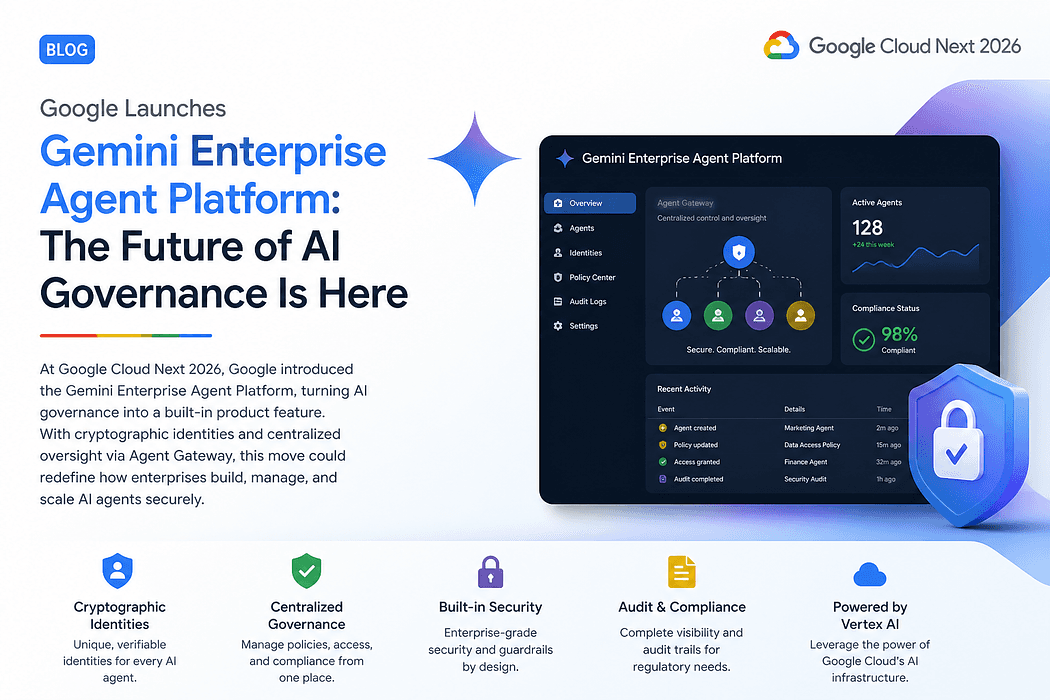
At the recent **Google Cloud Next 2026** conference, Google unveiled its answer: the **Gemini Enterprise Agent Platform**. This new solution aims to solve the growing crisis of **agentic AI governance**, providing businesses with the infrastructure to treat AI agents as securely as their human workforce.
Think of the Gemini Enterprise Agent Platform as the corporate operating system for the “agentic era.” Announced on April 22, 2026, this platform is the direct evolution and replacement of Google’s Vertex AI, absorbing all of its existing services and future development. It is designed as a "mission control" where developers and technical teams can build, scale, govern, and optimize entire fleets of autonomous agents.
Instead of managing isolated AI tools, the platform provides a unified stack to handle autonomous workflows. For example, an agent could process a supplier invoice, cross-check it against the company budget, and then automatically get approval from a manager without human intervention—all while leaving a secure audit trail.
The platform is organized around four critical pillars, placing **enterprise AI governance** at its core:
- Build: Developers can choose between low-code visual environments (Agent Studio) for business users or the code-first Agent Development Kit (ADK) for engineering teams. With access to over 200 models (including Gemini 3.1 Pro and third-party models like Claude), the platform supports virtually any use case.
- Scale: The re-engineered Agent Runtime supports long-living agents that can maintain state and context for days, backed by a persistent Memory Bank that remembers user preferences.
- Govern: This is the platform’s standout feature. It establishes centralized control through an Agent Registry and an Agent Gateway. Every agent, whether built internally or sourced from partners like Salesforce or Oracle, receives a cryptographically secure identity to ensure a clear audit trail for every action it takes.
- Optimize: Teams can stress-test agents against real-world scenarios using Agent Simulation and Evaluation tools, ensuring reliability before they are shipped.
Large enterprises are already leveraging these **AI agents** to transform their operations. Major brands including Comcast, PayPal, and L'Oreal are reported to be using the platform in production. Specific examples include:
- Comcast rebuilt its Xfinity Assistant, allowing customers to receive personalized, autonomous troubleshooting.
- PayPal is using the platform for agent-based payments and transaction deployments.
- Color Health powers a virtual cancer clinic that helps schedule screenings and analyze patient charts.
The Comcast example demonstrates how **Gemini Enterprise Agent Platform** can handle high-stakes customer interactions with full compliance.
For the modern enterprise, the shift here is significant. The primary benefit is eliminating AI "shadow IT," where employees deploy unvetted bots.
- Centralized Security: The Agent Gateway acts as a traffic controller, actively screening traffic to guarantee your sensitive data is never used for model training.
- Regulatory Compliance: For regulated industries like finance and healthcare, the platform ingests Access Control Lists from third-party systems (like Jira or SharePoint), ensuring agents only retrieve and summarize data a user is already authorized to see.
- Seamless Interoperability: The platform supports the Agent2Agent (A2A) protocol and Model Context Protocol (MCP), allowing agents built on Google Cloud to natively communicate with third-party SaaS applications without friction.
While powerful, migrating to the platform requires a strategic mindset. The complexity of managing thousands of agents demands a significant shift from traditional IT governance. Organizations currently reliant on legacy custom AI solutions may face a learning curve migrating from Vertex AI to the new Agent Platform ecosystem, though Google ensures API backward compatibility.
However, Google is actively bridging this gap. It has announced a $750 million partner fund and integrations with security giants like Check Point and Rubrik to provide additional runtime protection layers.
The launch of the Gemini Enterprise Agent Platform marks a turning point in artificial intelligence. As AI agents move from experimental pilots to production roles, they cannot be treated like search boxes. They must be managed with the same rigor as a payroll system or a quarterly financial report.
Google’s bet is clear. The future of the enterprise is not just intelligent, it is governed. For businesses looking to scale their AI workforce without creating digital chaos, Gemini Enterprise Agent Platform is defining the blueprint for the next generation of work.