
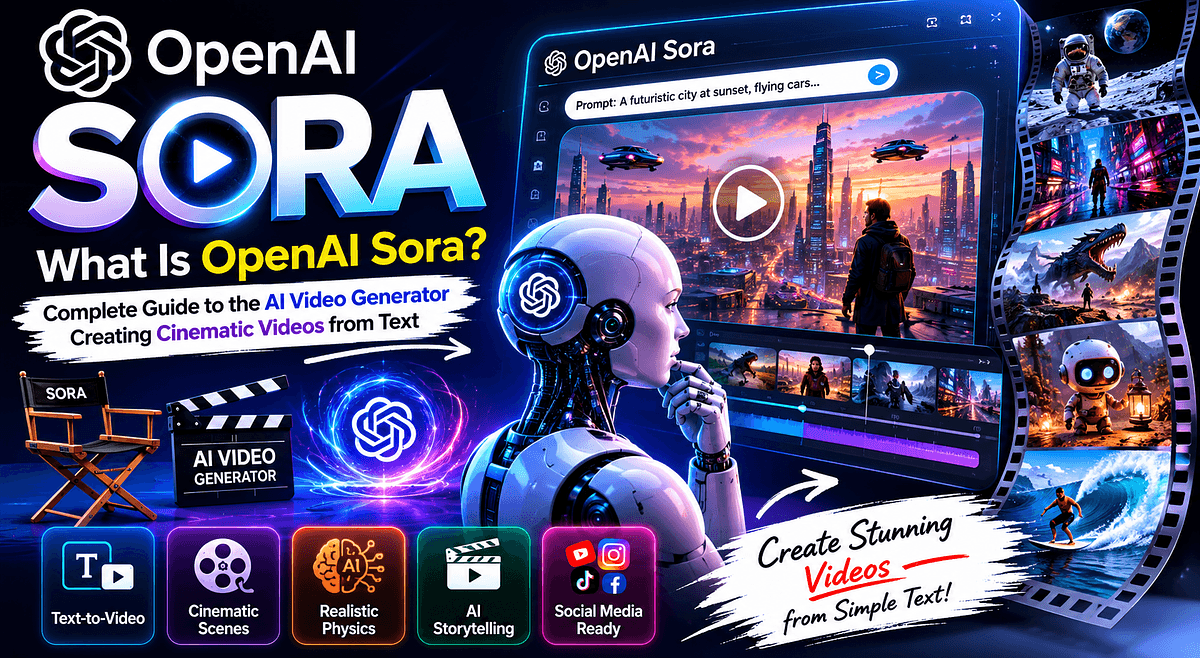
OpenAI Sora burst onto the scene as one of the most ambitious AI video generation tools, promising to turn simple text descriptions into cinematic, realistic videos. Launched in preview in early 2024 and evolving into Sora 2 by late 2025, it represented a major leap in generative AI. Users could describe scenes, and the model would produce coherent footage with impressive physics, character consistency, and even synchronized audio in later versions. Though the consumer-facing product has since been discontinued, understanding Sora remains essential for anyone interested in the rapid evolution of AI filmmaking tools.
OpenAI Sora is a text-to-video AI model developed by OpenAI. It generates short video clips from textual prompts, transforming words into dynamic visual sequences. Unlike earlier AI video tools that often produced choppy or unrealistic results, Sora aimed for cinematic quality, handling complex scenes, camera movements, and interactions between elements.
The model works by understanding the world in a way similar to how large language models process text. It was trained on vast amounts of video data, allowing it to simulate motion, lighting, textures, and even basic physics. Sora 2, released in September 2025, brought significant improvements in realism, controllability, longer video durations, and native audio generation with sound effects and dialogue.
This AI video creation tool stood out for its ability to create both realistic live-action style footage and imaginative animations from a single prompt.
Sora offered several standout capabilities that set it apart in the AI video generation platform space:
- Text-to-Video Generation: Users input detailed prompts, and Sora creates videos up to around 20-60 seconds, depending on the version and settings.
- Image and Video References: Later iterations supported image-to-video and extending existing clips, giving creators more control.
- Audio Integration: Sora 2 could generate videos with synchronized sound, including dialogue, music, and environmental effects.
- High Visual Fidelity: It excelled at maintaining consistency in characters, lighting, and scene composition across frames.
- Creative Controls: Features like remixing videos and character references allowed for more directed outputs.
These Sora AI features made it particularly appealing as a cinematic AI video maker for storytellers and content creators.
At its core, Sora functions as a diffusion model specialized for video. It starts with noise and gradually refines it into coherent visuals that match the prompt, while ensuring temporal consistency so the video flows naturally.
Users typically accessed it through the dedicated Sora app or sora.com. Effective prompts were detailed, specifying camera angles, mood, lighting, and action sequences. For example, instead of "a cat walking," a better prompt might be "A fluffy orange cat walks gracefully across a wooden kitchen counter at sunset, camera panning slowly from left to right, warm golden hour lighting."
Practical tip: Break complex scenes into multiple generations and use the remix feature to refine results.
Sora demonstrated its power through impressive examples. One early viral clip showed a woman walking through a neon-lit Tokyo street, with accurate reflections and atmospheric details. Another featured imaginative scenarios like a giant duck navigating city streets or historical reenactments that looked documentary-grade.
In professional contexts, filmmakers used it for storyboarding, concept visualization, and generating B-roll footage. Marketers created quick promotional videos, while educators produced animated explanations. Sora 2's audio capabilities enabled short narrative films with voiceovers and sound design directly from text.
These examples highlighted its potential as an AI filmmaking tool, reducing the time and cost barriers for video production.
The primary advantages of Sora as an OpenAI video generator included democratizing high-quality video creation. Independent creators could produce cinematic content without expensive equipment or large teams. It accelerated pre-production by allowing rapid visualization of ideas.
Businesses benefited from faster content creation for social media, advertising, and training materials. The tool supported various applications, from entertainment to education and marketing. Its realistic physics and motion helped bridge the gap between AI-generated and traditional video, making outputs more usable in professional workflows.
For intermediate users with some video editing knowledge, Sora served as a powerful starting point, with outputs that could be refined in tools like Adobe Premiere or DaVinci Resolve.
Despite its strengths, Sora had notable constraints. Video lengths were relatively short compared to full productions, and complex physics or causality could still produce artifacts. Character consistency across longer sequences sometimes faltered.
Access required subscriptions, often tied to ChatGPT plans, and generation was computationally intensive, leading to usage limits. Most significantly, as of April 26, 2026, the Sora web and app experiences were discontinued, with the API following later in September 2026. This shift reflected OpenAI's strategic pivot toward other priorities.
Users should consider ethical implications, such as potential for misinformation, and always verify outputs. Copyright and ownership of generated content also required attention.
Sora competed with tools like Google's Veo, Runway ML, Kling AI, and Luma Dream Machine. It often led in realism and prompt adherence during its peak, but alternatives sometimes offered longer generations, better integration with editing software, or different pricing models. Post-discontinuation, creators have shifted to these platforms for continued AI video creation needs.
Sora appealed to filmmakers, content creators, marketers, educators, and hobbyists exploring AI. It was ideal for those wanting to prototype ideas quickly or generate high-quality visuals without traditional production resources. Intermediate users benefited most by combining Sora outputs with their existing skills in scripting and editing.
Even with its current unavailability, studying its approach helps understand the direction of future AI video generation platforms.
OpenAI Sora marked a pivotal moment in generative AI, pushing boundaries of what's possible with text prompts. While the specific product is no longer active, its legacy influences ongoing developments in the field. Creators should explore current alternatives and stay informed about new releases from OpenAI and competitors.
Experiment with available tools, refine your prompting skills, and consider how these technologies can enhance your creative process. The era of accessible cinematic AI video making continues to evolve rapidly.