
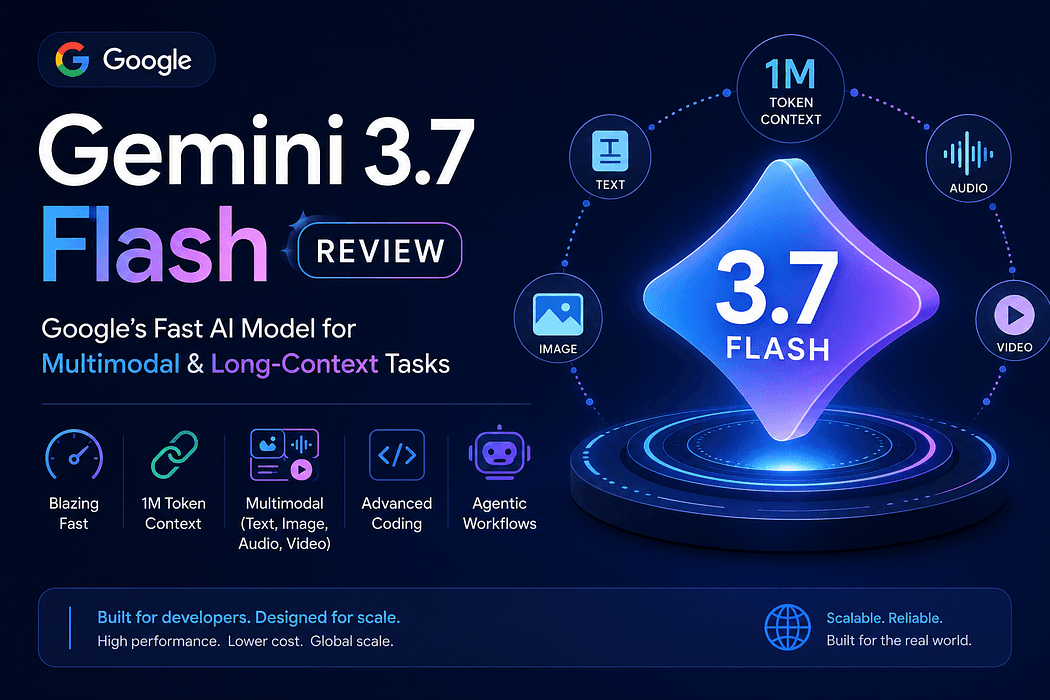
Google has spent 2026 releasing new Gemini models at a pace that few competitors can match, and Gemini 3.7 Flash is the clearest example yet of that strategy. Arriving just three weeks after Gemini 3.6 Flash, this release is not a wholesale rebuild but a refinement of the reasoning engine underneath it, aimed squarely at developers building coding tools and autonomous agents. For teams evaluating cost-effective AI models with genuine multimodal reach, this Gemini 3.7 Flash review breaks down what has actually changed, where it fits against GPT-5.6 and Grok 4.6, and who should be paying attention.
Gemini 3.7 Flash sits in the Flash tier of Google's Gemini 3 family, positioned as the workhorse between the deep-reasoning Pro models and the lighter, high-throughput Flash-Lite line. Google describes it as a refinement of Gemini 3.6 Flash rather than a new model trained from scratch, with algorithmic improvements applied to the existing reasoning foundation. That distinction matters for expert readers, since it explains why the gains concentrate in specific areas rather than showing up as a uniform jump across every benchmark.
The model accepts text, images, audio, and video, and processes all of it within a one million token context window, with output capped at 64,000 tokens. That places it firmly in the long-context AI model category, useful for tasks like reviewing entire codebases, summarizing lengthy legal filings, or analyzing hours of recorded audio in a single pass. Developers can also tune a thinking level parameter, choosing between low, medium, and high effort depending on whether the task favors speed or depth.
The headline improvements sit in three areas: software engineering, document-heavy knowledge work, and web development. On the FrontierCode 1.1 benchmark, Gemini 3.7 Flash scored 43.6 percent compared to 34.4 percent for its predecessor. On DeepSWE v1.1, a benchmark for autonomous software engineering, it reached 65.3 percent versus 49.0 percent. Those are meaningful jumps for a model that shipped only three weeks after the previous release, and they support Google's framing of this as its most capable AI coding model in the Flash lineup so far.
Beyond code, Gemini 3.7 Flash also improved on the GDP.pdf benchmark for complex document processing, moving from 22.0 percent to 34.0 percent, and on AutomationBench, a test of real-world business workflow completion, where it rose from 17.0 percent to 30.4 percent. That AutomationBench result is particularly relevant for teams building agentic AI workflows, since it reflects the model's ability to plan a task, use tools, recover from errors, and keep moving without constant human correction.
For AI for video analysis and AI for audio analysis specifically, the multimodal input support is the practical selling point. A single request can include a video file, an accompanying transcript, and a set of instructions, all processed together within the context window rather than requiring separate calls for each modality. Google has showcased this capability by pairing the model with its image generation tools to build interactive experiences and generate UI directly from screenshots or design references, which speaks to strong instruction following on visual input.
Consider a customer support team that needs to review recorded call audio alongside chat transcripts to identify recurring complaints. Gemini 3.7 Flash can ingest both in a single request and return a structured summary without stitching together outputs from separate models. A software team debugging a large legacy codebase can load relevant files directly into the context window rather than chunking them manually, letting the model trace an issue across multiple files at once. Marketing teams generating landing pages from design mockups can feed in a screenshot and receive working front-end code, a workflow Google has specifically highlighted in its own demonstrations.
Where Gemini 3.7 Flash distinguishes itself is price. Google is offering the model at an introductory rate of 0.75 dollars per million input tokens and 3.75 dollars per million output tokens through the end of 2026, after which pricing rises to 1.50 and 7.50 dollars respectively. That introductory rate undercuts both major rivals by a wide margin. Reporting on the launch pegged GPT-5.6 Terra's pricing at roughly 2.00 dollars per million input tokens and 12.00 dollars per million output tokens, meaning Gemini 3.7 Flash currently costs a fraction of that on a blended basis.
Grok 4.6 comparisons are harder to pin down with the same precision, since xAI has historically priced its lighter Grok variants aggressively on their own terms, and independent benchmarking of the 4.6 release specifically remains limited. What can be said is that GPT-5.6 continues to hold an edge in terminal and computer-use agent tasks according to early evaluations, while Gemini 3.7 Flash's strength lies in the combination of coding gains, native multimodal input, and a context window large enough to avoid the retrieval workarounds smaller-context models require. For teams weighing best AI models 2026 has to offer, the decision increasingly comes down to whether raw agentic precision or cost-per-task efficiency matters more for a given workload.
Benefits and Who Should Use It
Gemini 3.7 Flash is best suited to teams running high volume, and it rewards workloads where an agent makes many model calls per task, since lower token costs compound quickly at scale. Software teams building coding assistants, enterprises processing large document sets, and businesses building AI agents inside Google Workspace or the Gemini Enterprise Agent Platform are the clearest fits. Its availability through Gemini Spark also makes it accessible to individual Google AI Pro and Ultra subscribers who want an always-on personal agent rather than a developer-facing API.
The model is API and enterprise only, with no open weights available, so self-hosted or air-gapped deployments are not an option. Its knowledge cutoff remains fixed at March 2026, and Google has been explicit that this is an incremental refinement rather than a new base model, so expect narrower gains outside the three focus areas Google has highlighted. Teams evaluating computer-use or terminal-heavy agent tasks specifically may still find GPT-5.6 the stronger performer, and the introductory pricing is temporary, doubling on January 1, 2027, which should factor into any long-term cost projection.
Gemini 3.7 Flash reinforces Google's bet that frequent, targeted iteration beats waiting for a flagship release, and the result is a genuinely capable, cost-effective AI model for coding and agentic workflows. Its combination of a one million token context window, native multimodal input, and aggressive introductory pricing makes it a strong candidate for any team building agents or document-heavy applications at scale. Anyone currently weighing Gemini 3.7 Flash against GPT-5.6 or Grok 4.6 should test their specific workload against the free tier or trial pricing before committing, since the eventual price increase in 2027 is a real factor in total cost of ownership.