
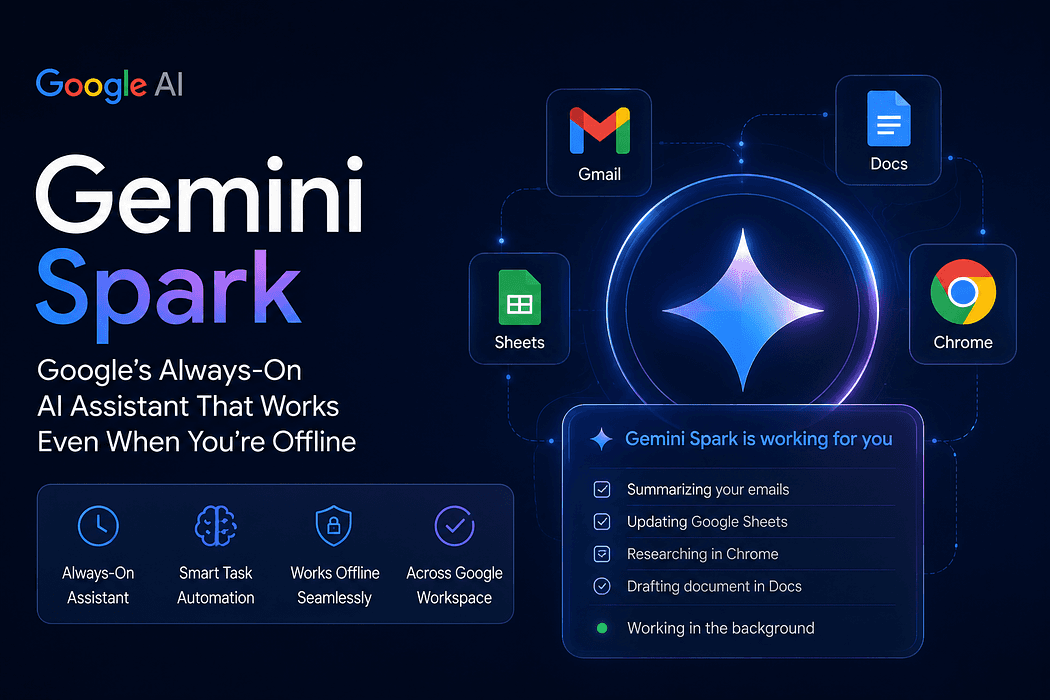
Gemini Spark is Google's new 24/7 personal AI agent designed to help users navigate their digital lives through autonomous background operation. Announced on May 19, 2026, during the Google I/O keynote as part of the broader agentic Gemini era, it runs on cloud-based virtual machines. This architecture allows it to function independently of local device power states or network connectivity.
Unlike conventional chat-based interfaces that respond only when prompted, Gemini Spark functions as a true AI automation assistant. It monitors connected services, applies user-defined goals or schedules, and completes tasks end-to-end. The system draws on Personal Intelligence capabilities to maintain context across applications while remaining under explicit user direction at all times.
Gemini Spark operates through a combination of conversational task definition, scheduled automation, and learned custom skills. Users describe objectives in natural language, after which the agent breaks them into actionable steps across linked services. It executes these steps persistently in the cloud, reporting progress or requesting confirmation before significant actions.
The underlying technology leverages advanced Gemini models, specifically Gemini 3.5 Flash alongside the Antigravity harness. Connections to Google services activate only when users enable them in settings. On-device processing handles certain observation tasks to support privacy, while heavier computation occurs in Google's secure cloud infrastructure. This hybrid approach enables the agent to remain active even when phones and laptops are powered off.
Gemini Spark organizes its functionality around three primary components that work together for sophisticated automation.
- **Tasks** handle one-off or complex multi-step workflows such as researching opportunities, organizing files, or synthesizing information from multiple sources.
- **Schedules** enable recurring or time-triggered actions, including weekly inbox reviews that generate prioritized to-do lists and calendar blocks for focused work.
- **Skills** allow the creation of personalized automations derived from analysis of user data, such as building an email drafting style guide from past correspondence.
Native integrations focus on the Google ecosystem, including Gmail, Calendar, Drive, Docs, Sheets, Slides, YouTube, and Google Maps. These connections support actions ranging from lead extraction and folder creation to invoice tracking and activity planning. The agent can also perform web research and synthesis when needed to supplement internal data.
Real-world applications demonstrate Gemini Spark's value in both personal and professional contexts. A user might instruct the agent to scan their inbox every Monday morning, extract key updates from the previous week, generate a prioritized action list, and reserve calendar time for deep work sessions.
Another common scenario involves file management: the agent can analyze a Google Drive repository, identify important documents, tag them appropriately, and compile metadata into a structured spreadsheet with contextual notes. For client-facing work, it can detect service inquiry emails, pull relevant details such as names and dates, log them into a tracking sheet, and automatically create corresponding project folders.
Hands-on testing has shown utility in consumer tasks as well, such as compiling packing lists that factor in weather forecasts and event constraints, identifying local activities within a specified radius, or monitoring price changes on tracked items over time. In each case, the agent operates without ongoing user input once the initial goal is established.
The primary advantage of Gemini Spark lies in its ability to reclaim time previously spent on repetitive or context-switching activities. By handling background monitoring and execution, it allows users to focus on higher-value work while maintaining consistent progress on ongoing objectives.
Because the agent runs in the cloud rather than requiring an always-awake local machine, it offers greater accessibility than many competing agentic systems. This design particularly benefits professionals who travel frequently or prefer to power down devices outside working hours. Integration depth within Google Workspace AI further reduces friction for organizations already invested in that ecosystem.
For expert users, the custom skills feature provides a low-code pathway to sophisticated personalization. Analyzing historical behavior to generate reusable automations represents a practical step toward more intuitive smart workflow automation without requiring programming expertise.
Despite its capabilities, Gemini Spark carries several practical limitations that warrant attention. Availability remains restricted during the initial rollout phase, currently limited to trusted testers and Google AI Ultra subscribers aged 18 and older in the United States, with gradual expansion planned for additional users and enterprise customers.
Privacy controls exist, and the system does not scan emails indiscriminately. However, users must carefully manage which applications the agent can access and review outputs regularly. The requirement for confirmation on major actions helps mitigate risk but can introduce occasional delays in fully autonomous scenarios.
Current integrations center predominantly on Google services, with broader third-party connections still maturing. Performance on highly nuanced or rapidly changing external platforms may require supplementary user intervention. As with any early-stage agentic system, occasional inaccuracies in interpretation or execution can occur, underscoring the need for appropriate oversight.
Gemini Spark delivers the greatest value to individuals and teams already embedded in the Google productivity suite who manage recurring digital workflows. Power users seeking to reduce manual coordination across email, documents, and scheduling will find immediate applications. Organizations exploring AI automation assistant strategies may also benefit from its enterprise-oriented deployment options.
Those less reliant on Google tools or who prefer fully local agent solutions may experience more limited utility until external integrations expand. Users comfortable with reviewing automated actions and iteratively refining instructions will achieve the best results.
Interested users can access Gemini Spark through the Gemini app or web interface once eligibility requirements are met. The process begins by enabling the feature and selectively connecting desired Google applications in settings. Starting with narrowly defined tasks allows users to evaluate behavior before expanding to scheduled or custom skill-based automations.
Best practices include providing clear, specific initial instructions, monitoring early outputs closely, and gradually building a library of personalized skills based on observed patterns. Regular review of agent activity helps maintain alignment with evolving priorities while strengthening overall system performance over time.
Gemini Spark marks a significant advancement in Google's approach to AI personal assistants by emphasizing persistent, proactive operation over purely conversational interfaces. As this technology matures and becomes more widely available, it offers a compelling model for how persistent AI agents can integrate into daily professional routines. Professionals focused on maximizing efficiency through Google AI innovations would benefit from evaluating its fit within their existing workflows as broader access expands.