
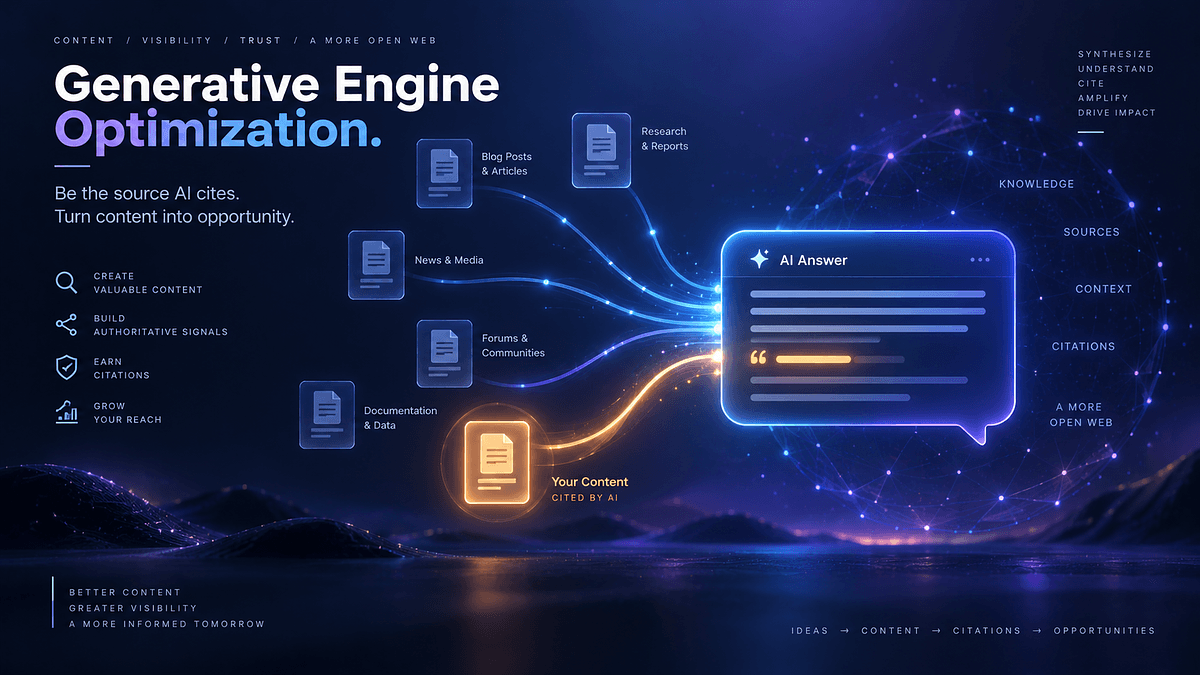
If your best content ranks on page one of Google but never shows up when someone asks ChatGPT the same question, you are not imagining a problem. You have run into the central challenge of Generative Engine Optimization (GEO), the practice of structuring and publishing content so that AI systems like ChatGPT, Perplexity, Gemini, and Google AI Overviews cite it when they answer a user's question. AI search engines already handle a meaningful share of English-language informational queries, and that share is climbing fast, which means the unit of competition has quietly shifted from a ranking position to a citation slot inside a generated answer. This guide walks through exactly what GEO involves and gives you a practical, step-by-step path to earning those citations.
GEO vs SEO is not a rivalry so much as an added layer on top of work you may already be doing. Traditional SEO measures whether a page ranks and whether a user clicks through to it, while GEO measures whether a page becomes part of the answer a user reads inside an AI assistant, often without ever visiting the source site at all. Strong domain authority, backlinks, and solid technical SEO still contribute directly to whether an AI system trusts and selects your content, so nothing you have already invested in SEO is wasted.
The practical difference shows up in how content gets consumed. A search engine ranks a full page against a query, but a generative engine retrieves a set of candidate pages, often through the very same underlying index that Google or Bing already maintain, and then extracts specific passages it can quote, paraphrase, or synthesize into a direct answer. That single distinction, extraction instead of ranking, is what the rest of this guide is built around.
With that foundation in place, the next step is understanding how each major AI engine actually finds and selects the content it cites.
Before optimizing anything, it helps to know that Google AI Overviews optimization, ChatGPT Search ranking, and getting cited by Perplexity are not identical problems. Google's AI Overviews draw heavily from the same web index and ranking signals used for traditional search results, so pages that already perform well in organic search have a real head start there. Perplexity has built its reputation on citation-forward answers, processing a large volume of monthly queries and consistently showing its sources, which makes it one of the more transparent engines to study and reverse-engineer.
ChatGPT Search and Bing-powered assistants lean on Bing's index for a meaningful portion of their retrieval, so a quick way to check your baseline visibility is searching site colon your domain directly in Bing rather than assuming Google performance tells the whole story. Running your most important queries through each engine and documenting where you appear versus where competitors appear gives you a concrete baseline before you change anything.
Once you know where you currently stand, the real optimization work begins with how the content itself is written and structured.
Content structure for AI answers follows a simple principle: make the answer easy to lift out of the page. Front-load the direct answer in the opening one or two sentences of a section rather than building up to it, since AI systems tend to extract the most concise, self-contained passage that answers the implied question. Follow that opening answer with supporting detail, and organize the rest of the page with clear, descriptive headings and a question-and-answer format wherever it fits naturally.
- Answer the core question in the first sentence of each section before adding context or nuance
- Use headings phrased as the actual questions people ask, not vague topic labels
- Keep individual paragraphs short so a single paragraph can stand alone as a citable unit
- Add structured data markup so machines can parse entities, authorship, and factual claims directly
That last point about structured data leads naturally into a technical requirement that trips up more sites than you would expect.
This step sounds almost too basic to mention, and that is exactly why it causes so many missed citations. One of the most common mistakes site owners make is unintentionally blocking AI crawlers, often because a robots.txt file copied from another site or a blanket disallow rule quietly bars GPTBot, Google-Extended, or PerplexityBot without anyone realizing it. Before doing anything else, audit your robots.txt file line by line and confirm that the specific crawlers you want visiting your site are not accidentally excluded.
A second, less obvious technical trap involves JavaScript rendering. Most AI crawlers do not execute JavaScript the way a browser does, so if your site is built on a client-side framework that renders content dynamically, an AI crawler may see an empty page where a human visitor sees a fully formed article. Server-side rendering or static generation for any page you want cited solves this problem directly.
With the crawling fundamentals sorted, it is worth addressing one specific file that generates a lot of confusion in the GEO conversation right now.
llms.txt AI crawlers discussions have generated a lot of hype that does not fully match reality, and it is worth being precise here rather than repeating the marketing version. llms.txt is a community convention, not a formally standardized protocol backed by a body like the IETF, and adoption sits at roughly one in ten domains, with independent traffic analysis showing that major AI search crawlers including GPTBot, ClaudeBot, and PerplexityBot largely skip fetching the file and crawl HTML directly instead.
Where llms.txt does show real value is in a different layer entirely: coding tools and IDE agents like Claude Code and GitHub Copilot routinely fetch a documentation site's llms.txt file to quickly identify which pages are worth pulling for a specific task. If your business publishes technical documentation that developers or AI agents interact with directly, adding an llms.txt file is a low-cost, sensible addition. If your goal is purely search citation visibility, treat it as a minor item on the checklist rather than the centerpiece of your strategy.
The far more consequential factor in whether an AI system trusts your content enough to cite it is something you cannot fake with a text file.
E-E-A-T for AI citations, experience, expertise, authoritativeness, and trustworthiness, functions as a filter that generative engines apply before they will quote or attribute a claim to your site. Clear, named authorship with visible credentials, consistent factual accuracy across your published content, and genuine third-party mentions and citations across the wider web all build the kind of entity authority that makes an AI system more confident citing you by name. It is worth being direct about what does not work here: manufacturing citations through mass-produced guest posts or planted mentions falls under scaled content abuse policies at major search engines and risks a penalty rather than a citation boost.
The honest path is earning genuine mentions through original research, clearly demonstrated first-hand experience, and consistent publication in your area of expertise, since these are precisely the signals that compound over time rather than the shortcuts that collapse under scrutiny.
AI search visibility tactics that work well produce a form of visibility that persists even without a click. Users increasingly act directly on what an AI answer tells them, buying a product referenced by name or adopting a recommendation without ever visiting the source site, which means brand influence can grow even as raw traffic numbers shift. Early evidence from businesses tracking this closely shows measurable referral sessions arriving from ChatGPT, Perplexity, Gemini, and Claude, traffic that would not have existed without deliberate GEO investment.
Answer engine optimization is still a maturing discipline, and measurement infrastructure has not caught up with the pace of adoption. A large share of brands currently have no dedicated GEO strategy at all, and an even larger share have no way to measure when they are actually being cited, which makes it hard to know what is working. Google Search Console's AI Overview filter in the Performance report is one of the few native measurement tools available today, and it is worth checking regularly even if your broader measurement stack is still incomplete.
It is also worth setting realistic expectations about attribution. Some AI assistants strip referrer data entirely, so a portion of genuine AI-driven visits will quietly land in your direct traffic bucket rather than showing up as an attributed AI referral, which means your actual citation impact is likely larger than your analytics currently reveal.
Generative Engine Optimization is not a replacement for SEO, it is the next layer built on top of it, and the fundamentals, crawlable pages, extractable structure, and genuine authority signals, matter more than any single technical trick. Start by auditing your robots.txt and rendering setup so AI crawlers can actually see your content, restructure your most important pages so answers sit in the first sentence of each section, and build authority through real expertise rather than manufactured mentions. The businesses that treat citation visibility as seriously as they once treated search rankings will be the ones AI systems are still quoting by name a year from now.