
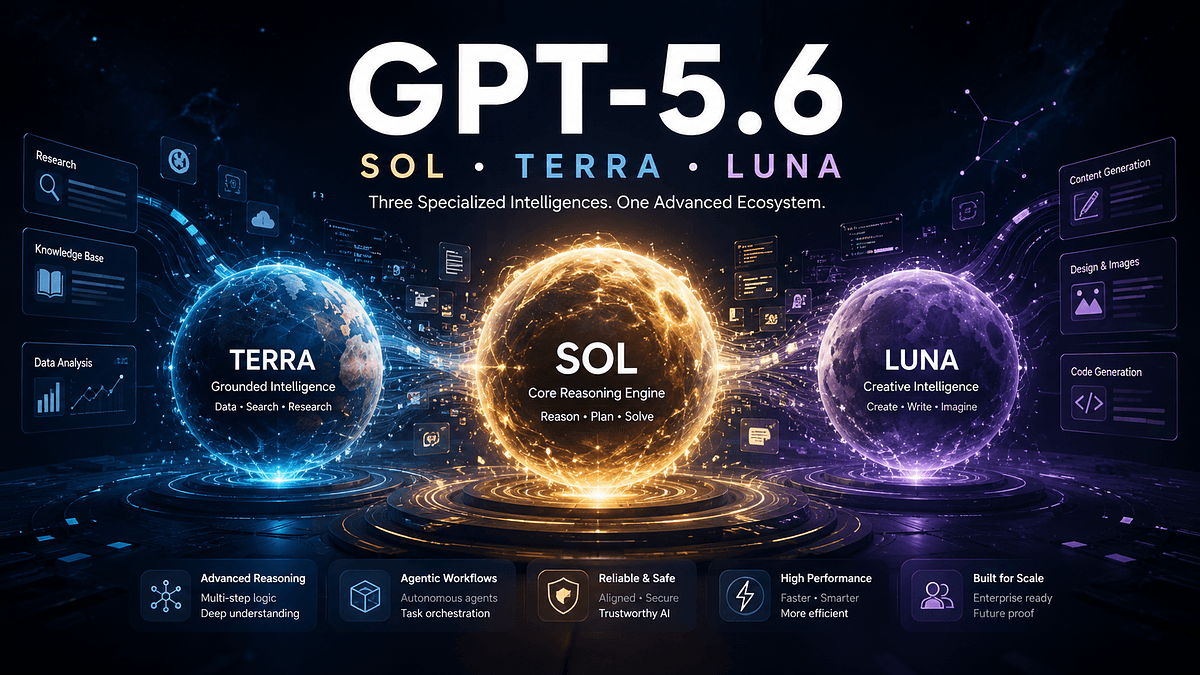
OpenAI has changed the way it ships frontier models, and this GPT-5.6 review breaks down exactly what that means for professionals who depend on AI for real work. Rather than releasing a single flagship, OpenAI launched GPT-5.6 as a family of three distinct tiers: Sol, Terra, and Luna. Each one targets a different point on the spectrum of intelligence, speed, and cost, and the choice between them now shapes how teams route work rather than which single model they adopt. This article unpacks what each GPT-5.6 model does well, how they compare to previous models, and who should actually be using them.
GPT-5.6 went to general availability on July 9, 2026, across ChatGPT, Codex, and the OpenAI API, following a limited preview coordinated with the US government. That preview period was itself notable. OpenAI previewed the family's capabilities to Washington ahead of launch and began with a small group of trusted partners before widening access, a first for a model release of this scale.
The naming convention is the other headline change. Instead of version strings like GPT-5.5 Thinking or GPT-5.4 mini, OpenAI now separates the generation number from the capability tier. The 5.6 identifies the generation, while Sol, Terra, and Luna are durable tiers that can each improve on their own schedule going forward. In practice, this means Terra can get smarter without OpenAI needing to rename it, and Luna can get faster without becoming Terra. The approach mirrors how Anthropic uses Haiku, Sonnet, and Opus, and how Google splits Gemini into Flash, Pro, and Ultra, giving buyers a name that communicates a role rather than a build number.
GPT-5.6 Sol is the flagship. It is built for frontier reasoning and long-horizon agentic work, and it is the tier OpenAI leads with on nearly every published benchmark. Sol is also the only model in the family that unlocks the new max reasoning effort and an ultra mode, which coordinates multiple agents working in parallel to finish demanding tasks faster.
GPT-5.6 Terra sits in the middle. OpenAI positions it as a balanced, everyday model with performance competitive to GPT-5.5 at roughly half the cost. For many production workflows, Terra is the practical default, with Sol reserved for genuinely hard escalations.
GPT-5.6 Luna is the fastest and most affordable tier. It is designed for high-volume, latency-sensitive work where raw speed and low cost matter more than squeezing out the last few points of capability.
Pricing reinforces the positioning. At general availability, API rates were five dollars input and thirty dollars output per million tokens for Sol, two dollars fifty cents and fifteen dollars for Terra, and one dollar and six dollars for Luna. On July 30, 2026, OpenAI cut Terra's price by twenty percent and Luna's by eighty percent, widening the cost gap between tiers considerably while Sol's price held flat compared with GPT-5.5.
On coding, the headline claim is that Sol set a new state of the art on the Artificial Analysis Coding Agent Index at 80 points, roughly 2.8 points ahead of the next-best model, while using under half the output tokens and taking under half the time of comparable runs. On Agents' Last Exam, an evaluation spanning long-running professional workflows across 55 fields, Sol posted a new high score, and OpenAI reported it beating Claude Fable 5 by a wide margin even at medium reasoning effort and a fraction of the estimated cost.
Cybersecurity capability jumped as well. On ExploitBench, Sol scored notably higher than GPT-5.5 at a comparable token budget, and OpenAI paired that gain with what it describes as its most robust safety stack to date, including strengthened protections around sensitive cyber requests and repeated misuse patterns.
It's worth noting these are OpenAI's own published numbers, and independent evaluators have flagged benchmark-gaming concerns industry-wide, so the real-world gap between GPT-5.6 and rival models like Claude's Opus and Fable tiers is likely narrower than the marketing charts suggest. Early hands-on impressions from developers have been positive on competence but mixed on whether Sol clearly outperforms competing frontier models on complex coding tasks.
Agentic AI models are where GPT-5.6 makes its strongest case. Sol is engineered to stay oriented across long coding sessions, follow more of a project's stated requirements, and handle the unglamorous cleanup work that determines whether an autonomous coding agent is actually useful in production. The family also introduces Programmatic Tool Calling, which lets the model write and execute JavaScript inside an isolated runtime with no network access, plus a multi-agent beta in the Responses API.
Integration across OpenAI's own tools is deep. GPT-5.6 Sol now powers ChatGPT's Instant and reasoning modes on paid plans, while Terra and Luna are available inside ChatGPT Work and Codex, OpenAI's dedicated coding environment. Developers get all three tiers through the API and through third-party platforms including GitHub Copilot and Amazon Bedrock, where usage counts toward existing cloud commitments.
For teams building AI tools for professionals, the tier system is genuinely useful. It turns model selection into a cost strategy: run high-volume classification or first-pass drafting on Luna, escalate scoped implementation and review work to Terra, and reserve Sol for the hardest reasoning chains, long document analysis, and multi-step agentic runs. That kind of routing is something a stakeholder can actually sign off on, unlike a version string.
The gains are not uniform across every benchmark. On SWE-Bench Pro, Sol trailed some competing models by a meaningful margin, and OpenAI itself published research suggesting a portion of that benchmark's tasks may be flawed, which complicates direct comparisons. Access is also uneven. Free and Go ChatGPT users get Luna by default rather than Sol, and Terra and Luna remain unavailable in standard consumer chat, limiting who can actually experiment with the full family firsthand.
GPT-5.6 Sol, Terra, and Luna mark a real shift in how OpenAI thinks about model releases, trading a single flagship for a tiered family built around intelligence, speed, and cost. Sol delivers genuine gains in agentic coding and long-horizon reasoning, Terra offers a strong cost-to-capability balance for everyday work, and Luna makes high-volume tasks dramatically cheaper. For professionals evaluating best AI models 2026 has to offer, the smart move is not picking one tier permanently but building a routing strategy across all three, while treating OpenAI's own benchmark claims with a healthy dose of independent verification.