
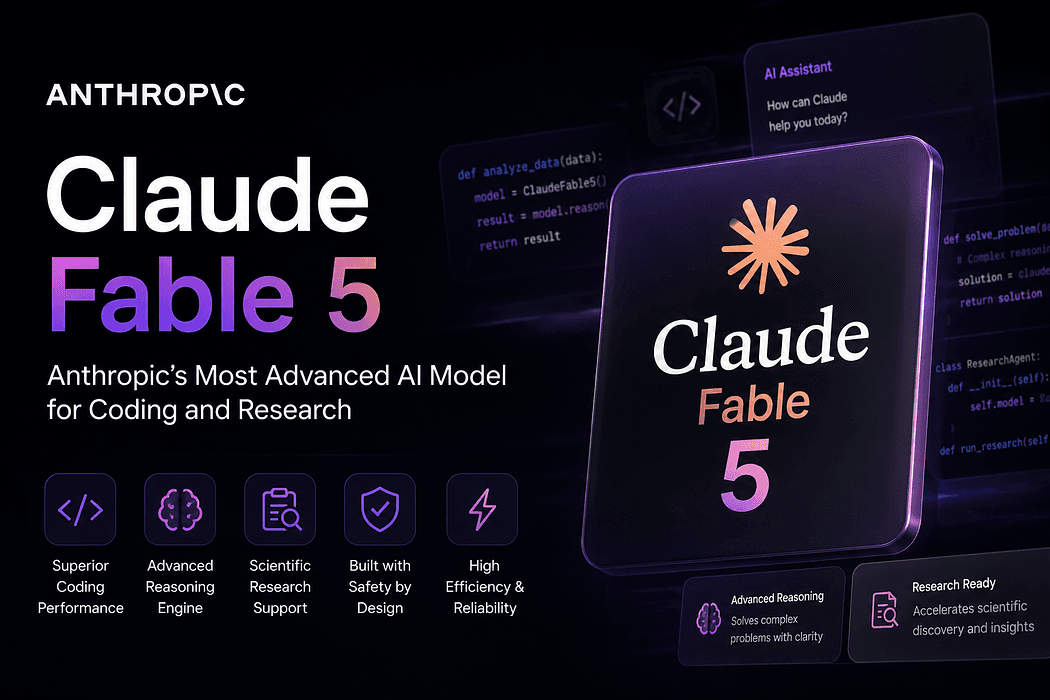
The landscape of artificial intelligence is transitioning from conversational chat assistants to autonomous agents capable of managing complex, multi-day workflows. Anthropic has advanced this shift with the release of Claude Fable 5, its most intelligent generally available frontier AI model. Built specifically to handle demanding logic, software engineering, and scientific research, this new model introduces unprecedented endurance to the enterprise market.
Understanding what makes this model unique requires looking beyond standard intelligence benchmarks. While past models excelled at answering immediate prompts, this system is engineered for long-horizon autonomy and independent execution. This article explores the core features, real-world performance, and practical limitations of Anthropic's latest flagship offering.
Alternative Title Options for A/B Testing:
Claude Fable 5 Deep Dive: Anthropic’s Elite Model for Developers and Researchers
Is Claude Fable 5 the Ultimate Software Engineering AI? Features, Benefits, and Limits
Inside Claude Fable 5: Decoding Anthropic’s New Mythos-Class Autonomous Agent
Claude Fable 5 represents the commercial, safeguarded version of Anthropic's internal Mythos architecture. While the restricted Mythos 5 model remains exclusive to specialized cybersecurity partners under Project Glasswing, Fable 5 delivers identical raw intelligence to general enterprise users and developers. The foundational upgrades focus heavily on sustained execution rather than just quick response accuracy.
The technical specifications of the model highlight its focus on heavy-duty enterprise operations. It features a default context window of 1 million tokens, paired with an industry-leading output capacity of up to 128,000 tokens per single request. This massive capacity allows the system to ingest entire codebases, dense legal dossiers, or multi-part scientific journals without losing contextual memory.
Operating with a default adaptive thinking mode, the model scales its internal reasoning process based on the difficulty of the prompt. This architecture ensures that simple tasks are handled rapidly, while highly complex logic problems trigger deep, multi-stage planning sessions before an output is generated. This strategic allocation of compute power makes the model a powerful asset for complex technical operations.
The primary differentiator for this system is long-horizon autonomy, which allows it to run for hours or even days inside an agentic framework. Traditional large language models often drift or lose track of instructions during long conversations, requiring frequent human intervention to stay on course. This model maintains structural focus throughout extended execution cycles, navigating blockers and tracking variables autonomously.
Another significant advancement is proactive self-verification. When tasked with a technical assignment, the system does not simply output a response and stop; it actively creates its own evaluation harnesses, writes testing scripts, and checks its own work. Coupled with advanced computer vision, the model can review visual layouts, charts, diagrams, and application screenshots to verify that its output matches the intended design goals.
Furthermore, the model excels at sub-agent orchestration, making it highly effective at coordinating multi-tiered workflows. It can act as a central manager, spinning up parallel sub-agents to tackle specific sub-tasks simultaneously, combining the results into a unified final delivery. This modular approach to problem-solving mirrors human team structures and significantly accelerates project completion times.
In practical software engineering environments, these autonomous capabilities translate to a dramatic compression of development timelines. Enterprise tech companies have utilized the system to execute massive, codebase-wide migrations across tens of millions of lines of legacy code in a single day. A project of that scale typically demands months of manual labor from an entire engineering squad, but the model handles the file tracking, dependency updates, and automated code rewrites independently.
Beyond software development, the system is driving efficiency inside data-heavy scientific and financial research workflows. Analysts utilize its advanced multimodal vision to parse complex financial charts, nested data tables, and structural diagrams hidden deep within massive PDF documents. The model can accurately synthesize these disparate data formats, cross-reference historical datasets, and highlight subtle anomalies that human reviewers might overlook.
In laboratory environments, research teams deploy the model to accelerate literature reviews and formulate experimental hypotheses. Because it can process a million tokens of data simultaneously, scientists can feed the model dozens of recent academic papers at once. The system then extracts relevant methodologies, highlights conflicting data points, and outlines optimized paths for physical laboratory testing.
The operational advantages of adopting this tier of intelligence are clear for organizations managing complex automation. First-shot correctness on intricate tasks reduces the time developers spend debugging AI-generated code, while the ability to delegate long runs frees human experts to focus on high-level architecture. Enterprise platforms like Databricks have natively integrated the model via unified gateways, allowing corporations to run these advanced agents directly against secure internal data.
However, elite intelligence commands a premium price point in the cloud infrastructure market. The model is priced at $10 per million input tokens and $50 per million output tokens, making it roughly twice as expensive to operate as previous flagship models like Claude Opus 4.8. For routine daily tasks like drafting simple emails or basic text formatting, the massive computational cost and slower processing speeds are difficult to justify commercially.
Enterprise buyers must evaluate their workloads to determine where this investment yields a positive return. Organizations report a higher return on investment when applying the model to highly complex, multi-variable problems where cheaper models fail completely. In these scenarios, paying a premium for a successful autonomous run eliminates the massive hidden costs of failed computing cycles and manual human troubleshooting.
A critical aspect of deploying this technology is understanding the robust digital safety classifiers built directly into the framework. Because the underlying architecture possesses advanced capabilities in sensitive fields like cybersecurity and biochemistry, Anthropic has implemented real-time safety filters to prevent potential misuse. If a prompt triggers alerts regarding exploit generation or chemical synthesis, the model halts execution and safely redirects the query to a lower-tier model.
Operationally, the deep reasoning engine can lead to a noticeable increase in processing latency and occasional execution timeouts. Because the system spends significant time verifying assumptions and exploring edge cases, it runs roughly 30 percent slower than standard commercial models. Development teams building real-time applications must account for these extended thinking cycles when designing user interfaces and setting API timeout thresholds.
Data retention policies represent another crucial compliance factor for enterprise deployment. The model requires a standard 30-day data retention window to allow for comprehensive pattern analysis and safety auditing, meaning it does not support zero data retention configurations at launch. Organizations operating under strict privacy frameworks must ensure their data compliance pipelines align with these platform requirements before migrating production workloads.
Claude Fable 5 marks a definitive transition from simple prompt-and-response AI to reliable, long-horizon autonomous agents. By combining deep reasoning, proactive self-verification, and multi-agent coordination, the model provides the technical infrastructure required to automate highly complex engineering and research workflows. While the computational costs and processing speeds require deliberate resource allocation, the potential gains in operational efficiency are substantial for technical teams.
To maximize the value of this advanced technology, organizations should begin by identifying highly specialized, multi-day engineering bottlenecks that currently drain human resources. Implementing the model inside governed agent frameworks allows teams to safely test its self-verification and code migration capabilities on contained projects. Monitoring the token consumption and success rates of these initial runs will provide the empirical data needed to scale autonomous operations effectively across the wider enterprise.