
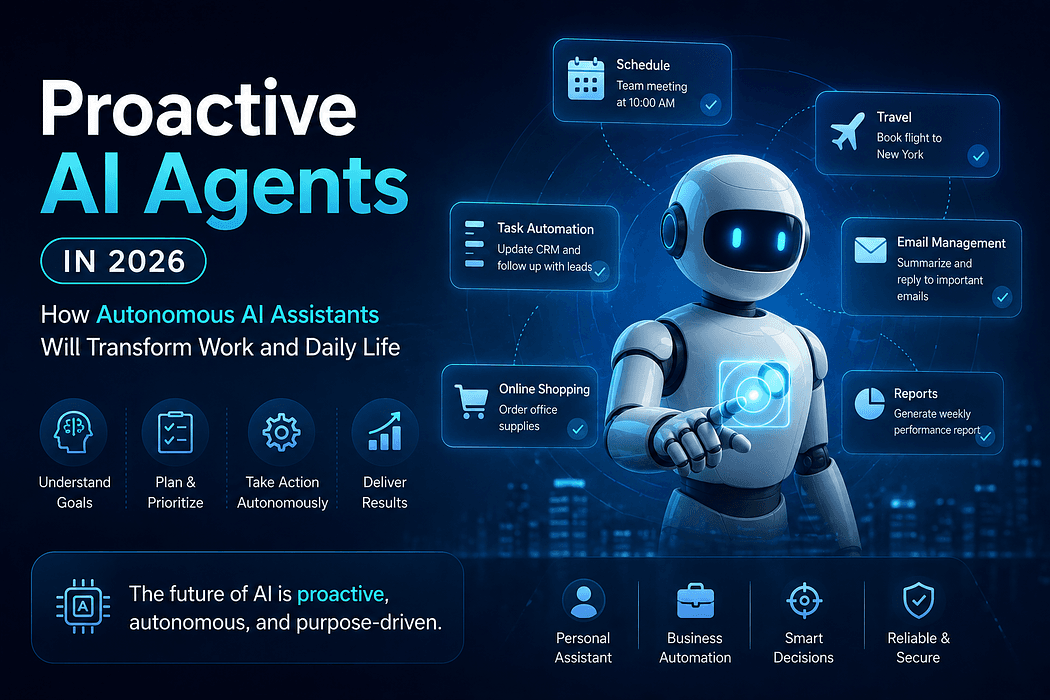
For years, working with artificial intelligence meant asking a question and waiting for an answer. Type a prompt, get a response, repeat. That interaction model, however useful, has always placed the burden of initiative on the human. In 2026, that dynamic is being rewritten. Proactive AI agents are emerging as a distinct category of technology, one that does not simply respond to instructions but understands goals, plans multi-step actions, and executes tasks with minimal supervision. This shift from reactive chatbots to autonomous AI agents represents one of the most consequential developments in the AI industry, and it is poised to change how professionals work and how individuals manage their daily lives.
Traditional AI assistants operate on a simple request and response loop. A user asks a question, the system retrieves or generates an answer, and the interaction ends. Proactive AI agents operate differently. They are designed to hold a goal in memory, break it into subtasks, use external tools or applications, and adjust their approach when circumstances change.
This is the essence of agentic AI. Instead of waiting for explicit instructions at every step, an autonomous AI agent can independently decide which actions to take next in order to accomplish an objective. If a first attempt fails, the agent can try an alternative approach without needing the user to intervene.
The technical foundation for this shift rests on several converging capabilities: extended reasoning, persistent memory, tool use, and the ability to observe outcomes and self-correct. Modern AI decision-making agents can evaluate multiple possible paths toward a goal, weigh trade-offs, and select the option most likely to succeed. This mirrors how a competent human assistant would approach an ambiguous task, using judgment rather than following a rigid script.
The theoretical promise of agentic AI becomes tangible when examined through practical use cases. Across both business and personal contexts, proactive AI agents are already demonstrating measurable value.
In enterprise settings, AI workflow automation is moving beyond simple robotic process automation. Proactive agents can now monitor a sales pipeline, identify stalled deals, draft personalized follow-up communications, and schedule outreach, all without a human manager assigning each step individually.
Customer support is another area of rapid adoption. Rather than routing every inquiry to a human agent, an autonomous AI agent can diagnose the issue, consult internal documentation, execute a fix, and only escalate to a person when the situation genuinely requires human judgment. This reduces resolution time while allowing human staff to focus on complex or sensitive cases.
Software development teams are also benefiting. Coding agents can now be assigned a bug report or feature request, explore a codebase, write and test a solution, and open a pull request for review. Developers shift from writing every line of code to supervising and validating the work of their AI counterparts.
On the consumer side, intelligent AI assistants are taking on tasks that once required significant manual coordination. Booking a multi-city trip, for example, no longer means comparing dozens of browser tabs. A proactive agent can research flight and hotel options, apply stated preferences such as budget or airline loyalty status, and complete the booking, checking in with the user only at key decision points.
Calendar and schedule management follows a similar pattern. Instead of manually finding a meeting time that works for multiple parties, an AI assistant can negotiate scheduling directly with other people's calendars or their own AI agents, proposing a final time only once consensus is reached.
Household and administrative tasks, from renewing subscriptions to tracking warranties and filing expense reports, are increasingly delegated to AI task automation systems that operate quietly in the background.
The appeal of proactive AI agents lies in the combination of time savings, consistency, and scale. Understanding these benefits clarifies why adoption is accelerating so quickly heading into 2026.
Time efficiency stands out as the most immediate benefit. Tasks that once required sustained human attention across multiple applications can now be delegated entirely, freeing knowledge workers to focus on higher-value judgment calls.
Consistency is another advantage. Unlike humans, autonomous AI agents do not experience fatigue or lapses in attention during repetitive tasks, which reduces errors in processes like data entry, compliance checks, or routine reporting.
Scalability further distinguishes agentic systems from earlier automation tools. A single well-designed agent can be deployed across hundreds of parallel workflows simultaneously, something that would require significant additional headcount using traditional methods.
Finally, proactive agents enable a shift in how people relate to their tools. Rather than operating software directly, users increasingly describe outcomes and let the AI assistant determine the steps, a change that lowers the technical barrier for complex tasks.
Despite the momentum behind the future of AI assistants, proactive agents are not without meaningful limitations that organizations and individuals should weigh carefully.
Trust and oversight remain central concerns. Granting an AI agent the ability to take real-world actions, such as making purchases or sending communications on someone's behalf, requires robust permission systems and clear boundaries around what the agent can do autonomously versus what still requires explicit approval.
Reliability in ambiguous situations is another open challenge. While AI decision-making agents have improved substantially, they can still misinterpret goals or make suboptimal choices when instructions are vague or when unexpected edge cases arise.
Data privacy and security also demand attention. Agents that connect to email, calendars, financial accounts, or internal business systems inherently expand the attack surface, making strong authentication and monitoring essential.
Organizations adopting these systems should implement staged rollouts, starting with lower-stakes tasks before expanding an agent's autonomy, and should maintain clear audit trails of agent actions for accountability.
Proactive AI agents mark a genuine inflection point in how people interact with technology. Moving beyond the question-and-answer format of earlier chatbots, these autonomous AI assistants are demonstrating a growing capacity to understand goals, make decisions, and complete complex tasks with limited human input. From AI agents for business handling workflow automation to AI personal assistants managing everyday logistics, the practical applications are expanding rapidly across 2026.
The organizations and individuals who benefit most will be those who approach this technology thoughtfully, starting with well-defined use cases, maintaining appropriate oversight, and gradually expanding the scope of what they delegate. As agentic AI continues to mature, the distinction between using a tool and collaborating with an intelligent assistant will only continue to blur.