
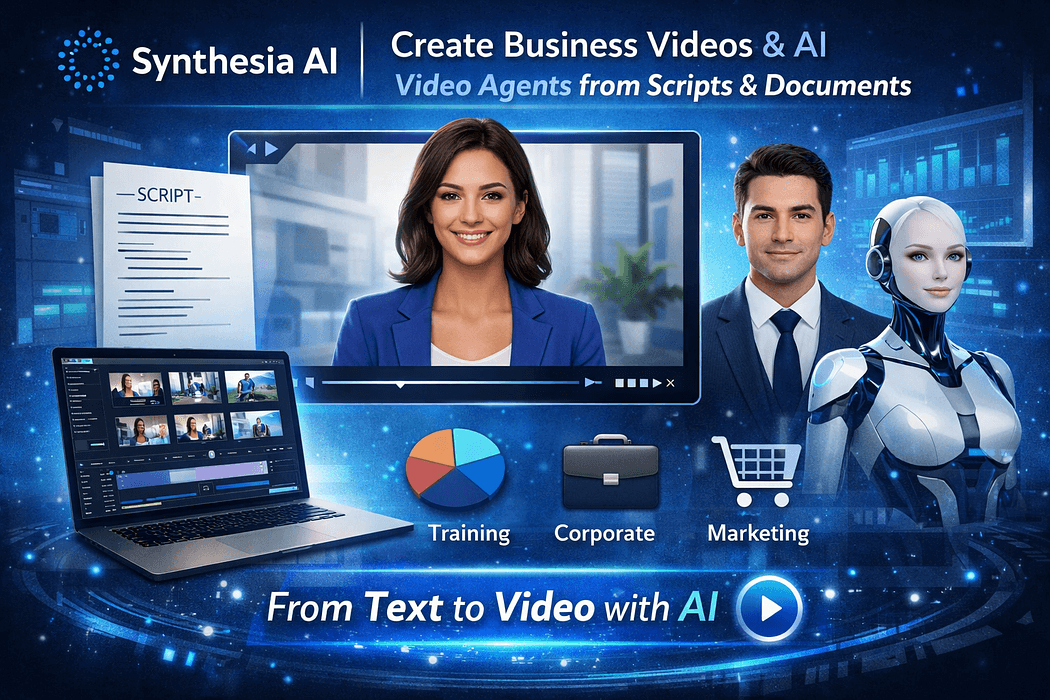
What if you could produce a polished, professional video in the time it takes to make a cup of coffee? No camera. No studio. No actors. No editing software. Just type your script, pick a digital presenter, and hit generate. That is exactly what the Synthesia AI video generator does, and over 60,000 companies including 90 percent of the Fortune 100 are already using it to do just that. So what is all the fuss about, and is it actually worth it for your team?
Synthesia is a London-based AI video creation platform that launched in 2017 out of research at University College London. The core idea is simple: you write a script, and Synthesia turns it into a professional-looking video featuring a realistic AI avatar reading your words aloud, with synchronized lip movements, natural gestures, and a polished background.
Think of it like ordering a really good suit off the rack rather than having one custom tailored. Traditional video production is expensive, time-consuming, and requires a crew. Synthesia lets you walk out the door with something professional-looking in a fraction of the time. That analogy has proven compelling enough for investors to value the company at four billion dollars as of late 2025, making it the most valuable AI video company in the world.
The platform has evolved well beyond its original premise. Synthesia 3.0, announced in October 2025, introduced a fundamentally new vision of what business video can be, shifting from a one-way broadcast format toward two-way, interactive, personalized video experiences. It is a genuinely significant upgrade, and understanding what it adds changes how you should be thinking about the tool.
Getting a video made on Synthesia is straightforward enough that 90 percent of users publish their first video without needing a tutorial, according to the company. You start by writing or pasting your script into the editor. If you are staring at a blank page, Synthesia's built-in AI script generator can draft one for you based on a short prompt. You can also import a PDF, a PowerPoint deck, a website URL, or a document directly, and the platform will convert it into a structured video script automatically.
Next, you pick your visual setup. Synthesia offers over 250 ready-made templates for business presentations, HR updates, training content, and product demos. Then you choose an AI avatar from a library of over 230 options covering a wide range of ethnicities and ages. For enterprise users, there is also the option to create a personal avatar, a digital twin of yourself or a team member, using a single uploaded image.
The final step is the voiceover. You select from over 400 voices across 160 languages and accents. You can preview voices, insert pauses, and adjust pronunciation of brand names or technical terms through a built-in dictionary. Hit generate, and your video is typically ready within a few minutes. What used to take a production team four hours now takes around thirty minutes in total, including script writing.
Here is where Synthesia 3.0 gets genuinely exciting. Traditional video is a one-way street. You create it, your audience watches it, and nothing changes. Synthesia's Video Agents, rolling out for enterprise customers in early 2026, flip that dynamic entirely.
Imagine a training video where the AI avatar pauses and asks your employee a question. The employee answers. The avatar responds based on what they said, adapts the next section of content to their response, and can even score their performance. That is not a hypothetical feature anymore. It is exactly what Video Agents deliver, and the implications for corporate training are significant.
A bank training tellers on difficult customer conversations does not need to film scenario role-plays with actors anymore. They create a Video Agent that plays the difficult customer, responds to whatever the teller says, gives real-time feedback, and measures soft skills at scale. That kind of training previously required in-person workshops or costly live simulations. Video Agents make it available on demand, at any scale, in any language.
One of Synthesia's most practically powerful features is its one-click translation. You create a video once in English, click translate, and Synthesia generates versions in 80 or more languages with the avatar's voice and lip movements perfectly synchronized to the new language. It is not adding subtitles. It is actually reproducing the video in a different language with matching lip sync.
Electrolux uses Synthesia to train 15,000 employees across Europe in over 30 languages. Doing that with traditional video production would require hiring voiceover artists and re-editing each language version separately. With Synthesia, the same video asset works across the entire organization, in every relevant language, updated as quickly as someone can edit a text document.
There is a catch worth knowing: the one-click translation to 80 languages is an enterprise plan feature. The starter plans support a solid range of languages for generation, but the full multilingual dubbing capability with frame-accurate lip sync is locked behind the enterprise tier. For global organizations, it is almost certainly worth it. For smaller teams, it is a feature to keep in mind as you grow.
This is where Synthesia genuinely shines. Companies use it for everything from compliance training and onboarding videos to software rollouts and HR policy updates. The real win is how simple updates become. When a process changes, you just edit the script text and regenerate. No studio booking, no actor fees, no reshoots. Five Below saved 56,000 dollars while creating over 100 custom training videos using this exact workflow.
Marketing teams use Synthesia to produce product demos, personalized outreach videos, and social media clips without getting stuck in production logistics. The ability to quickly generate a localized version of a product demo for a different market, or to update a demo video when the product changes without a full reshoot, removes a bottleneck that previously forced many marketing teams to keep video volume low.
SaaS companies are using Synthesia to build interactive product walkthroughs where the Video Agent guides new users through features step by step, asking them to try actions and responding based on what they click or answer. Maryville University reported saving 35 percent of their time compared to their previous AI video workflow by switching to Synthesia for student onboarding and course content.
Synthesia is not perfect, and it is worth knowing where it falls short before you commit. The AI avatars can still feel slightly stiff in longer videos. They have gotten significantly more natural with the Express-2 engine's gesture and expression updates, but if you are comparing them to a charismatic human presenter, there is still a visible gap in energy and spontaneity.
The pricing model is based on video minutes generated per year, and it can feel restrictive for teams with high-volume needs on the lower-tier plans. The free plan gives you 10 minutes of video per month with nine stock avatars, which is useful for testing but not enough for regular production use. Paid plans start at 18 dollars per month annually, scaling up to custom enterprise pricing.
Several of the most powerful features, including one-click translation to 80 languages, Generative Assets with Veo 3.1, and Video Agents, are currently enterprise-only. If your team is on a starter or creator plan, you are working with a capable but meaningfully reduced version of what the platform can actually do. Budgeting for the appropriate plan tier up front is worth doing before integrating Synthesia into a core workflow.
The most common comparison is Synthesia versus HeyGen, and both are genuinely good tools. Synthesia is the stronger choice for enterprise teams focused on corporate training, compliance, and secure internal video production. It has passed compliance audits at 90 percent of the Fortune 100, is SOC 2 Type II and GDPR compliant, and its collaboration and access control features are built for teams rather than individuals.
HeyGen offers more creative flexibility and is generally the better choice for individual creators, marketing content, and social media video. Synthesia starts at 18 dollars per month while HeyGen starts at 24 dollars per month, making Synthesia the more cost-effective entry point for business use. If you are a solo content creator rather than a business team, HeyGen's creative toolkit is likely a better fit.
Synthesia AI has earned its position as the leading business video creation platform for a reason. The combination of fast text to video production, 160-language support, brand customization, and now interactive Video Agents addresses a genuine operational challenge that affects almost every mid-to-large organization. The platform can save teams up to 80 percent of the time and cost associated with traditional video production, and real-world case studies back that claim up.
The free plan is genuinely useful for evaluation, so the lowest-risk path forward is to start there, run a real project through the workflow, and see whether the output quality meets your brand standard. If it does, the time and cost savings make the paid plan a straightforward business case. If your team regularly produces training, onboarding, compliance, or product education content, Synthesia is one of those rare tools where the value is obvious from the first session.
The arrival of Video Agents in 2026 is the feature to watch. When interactive, personalized AI video becomes the standard format for corporate training and customer onboarding, the organizations already fluent with the Synthesia platform will have a significant head start. Getting familiar with the tool now is not just about saving time today. It is about being ready for what business video is becoming.