
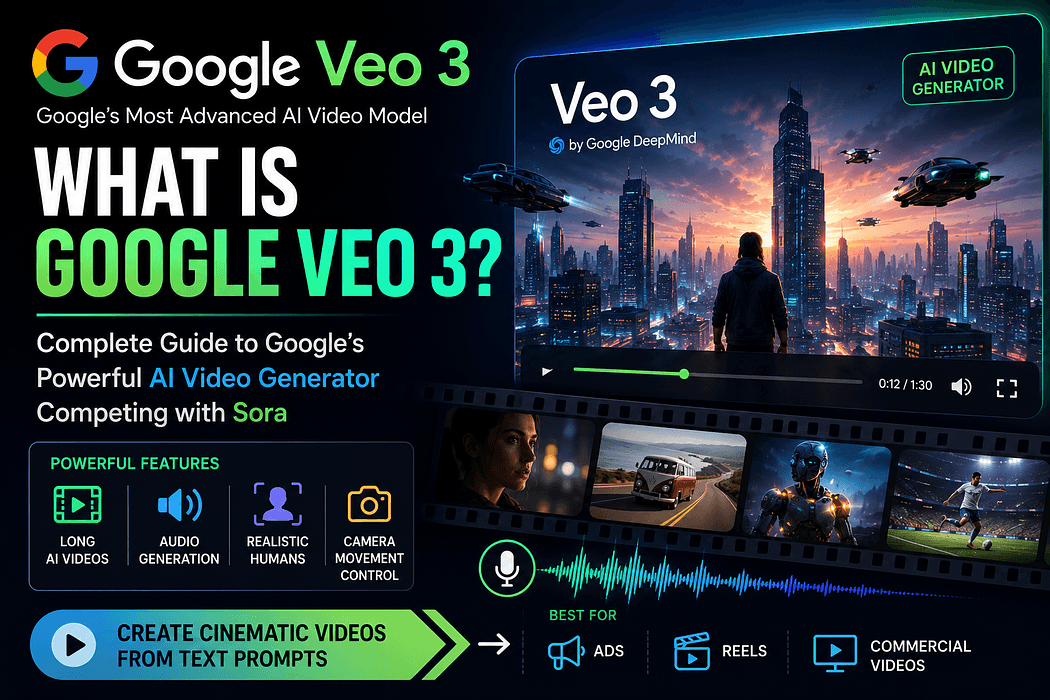
Google continues to push the boundaries of artificial intelligence with its video generation tools. Among the latest advancements stands Google Veo 3, a sophisticated AI video generator developed by Google DeepMind that transforms text prompts into cinematic video clips complete with synchronized audio. As one of the leading contenders in the generative video space, it directly challenges models like OpenAI's Sora by delivering high-fidelity visuals paired with native sound generation.
This comprehensive guide explores what makes Google Veo 3 distinctive, its core capabilities, practical applications, and how it fits into the evolving landscape of AI video creation tools. Whether you are a content creator, marketer, or filmmaker exploring AI possibilities, understanding this technology offers valuable insights into the future of visual storytelling.
Google Veo 3 represents DeepMind's flagship video generation model. Released initially in May 2025, it builds on previous versions with significant enhancements in realism, prompt adherence, and audio integration. The model generates short video clips, typically around eight seconds in high resolutions up to 4K, from simple text descriptions or reference images.
Unlike earlier text-to-video systems that produced silent footage, Veo 3 incorporates native audio generation. This includes dialogue, sound effects, ambient noise, and background music that align naturally with the on-screen action. The latest Veo 3.1 update, introduced in October 2025, further refines these features with richer audio, improved narrative control, and better support for vertical and landscape formats.
Several technical capabilities set Veo 3 apart as a robust AI cinematic video generator. It supports multiple aspect ratios, including 16:9 for traditional video and 9:16 for social media platforms like YouTube Shorts. Users can generate videos in 720p, 1080p, or 4K resolutions, depending on the variant chosen.
Advanced creative controls include reference image guidance for maintaining character and style consistency across scenes. The model excels at understanding cinematic terminology, such as "aerial shot," "timelapse," or specific lighting conditions, allowing precise creative direction. Additional tools enable extending clips, creating seamless transitions, and even object removal or insertion while preserving realistic physics and shadows.
A standout element remains its native audio capabilities. Veo 3 generates synchronized dialogue, voice-overs, and environmental sounds directly within the video, eliminating the need for separate post-production audio layering in many cases.
Accessing the Google AI video creator typically occurs through platforms like Google AI Studio, Gemini app, Google Vids, or the specialized Flow filmmaking tool. Users with appropriate subscriptions can input detailed text prompts describing the desired scene, characters, actions, and mood.
Effective prompting involves specificity. For instance, instead of "a dog running," a better prompt might read: "A golden retriever with glossy fur sprints playfully through a sunlit meadow of wildflowers, camera panning smoothly from left to right, golden hour lighting, cinematic style with subtle background piano music." Including details about camera movement, lighting, and audio enhances results significantly.
The process involves selecting resolution and aspect ratio, then generating the clip. Users can iterate by refining prompts or using reference images to guide consistency. Integration with tools like Flow allows for more complex editing and sequencing of multiple generated clips.
Practical applications of Veo 3 demonstrate its versatility. Marketing teams create short promotional videos featuring products with realistic demonstrations and voice-over narration. A beverage company might generate a clip showing ice cubes clinking in a glass with satisfying fizz sounds and a narrator describing the flavor profile.
Filmmakers use it for storyboarding or pre-visualization. An independent director could quickly prototype a scene of a tense chase through rainy streets, complete with splashing puddles, distant sirens, and character dialogue. Educational content creators produce engaging explainer videos with animated sequences and clear spoken explanations.
Social media influencers leverage the tool for quick, high-quality vertical content. A travel creator might prompt: "Smooth drone shot gliding over misty mountain peaks at sunrise with gentle wind sounds and soft inspirational music," generating ready-to-post material in minutes.
Benefits of Using Veo 3 as an AI Video Creation Tool
The primary advantages include dramatic reductions in production time and costs. Traditional video creation requires cameras, lighting, actors, locations, and editing teams. Veo 3 compresses much of this workflow into prompt-based generation, making professional-looking content accessible to smaller teams and individuals.
Its realism in physics, textures, and human movement surpasses many competitors, producing videos that feel authentic rather than artificial. Native audio integration creates more immersive experiences without additional tools. For businesses, this translates to faster campaign turnaround and more creative experimentation.
As a prominent OpenAI Sora competitor, Veo 3 differentiates itself through superior native audio capabilities and strong prompt adherence for technical specifications. While Sora excels in certain narrative flows and photorealistic human expressions, Veo 3 often performs better in maintaining consistency across scenes and handling complex camera movements.
Veo 3 tends to favor higher production quality and integration within Google's ecosystem, making it particularly suitable for professional and enterprise applications. Both models continue evolving rapidly, with ongoing improvements in length, resolution, and control.
Despite its strengths, Google Veo 3 has constraints. Generated clips remain relatively short, typically under ten seconds for highest quality outputs, though extensions and sequencing help create longer content. Access requires subscriptions, with usage limits based on plan tiers.
Like all generative AI tools, it raises considerations around authenticity, copyright, and potential misuse. Google implements safeguards and watermarks on outputs to promote responsible use. Results can vary based on prompt quality, and complex or highly specific scenes may require multiple iterations.
This AI video generator suits content creators, digital marketers, educators, and filmmakers seeking efficient ways to produce high-quality visuals. Small businesses benefit from cost-effective promotional materials, while larger organizations use it for rapid prototyping and concept testing. Anyone interested in exploring AI filmmaking platforms will find Veo 3 offers a powerful entry point with room for creative growth.
Google Veo 3 stands as a significant milestone in AI-powered video generation. Its combination of stunning visual realism, native audio, and advanced creative controls positions it as a formidable tool in the hands of modern storytellers. As the technology matures, it promises to further democratize high-quality video production.
The future of content creation increasingly involves collaboration between human creativity and AI capabilities. Exploring Google Veo 3 today provides valuable experience with tools shaping tomorrow's media landscape. Experiment with different prompts and applications to discover how this realistic AI video maker can enhance your projects.