
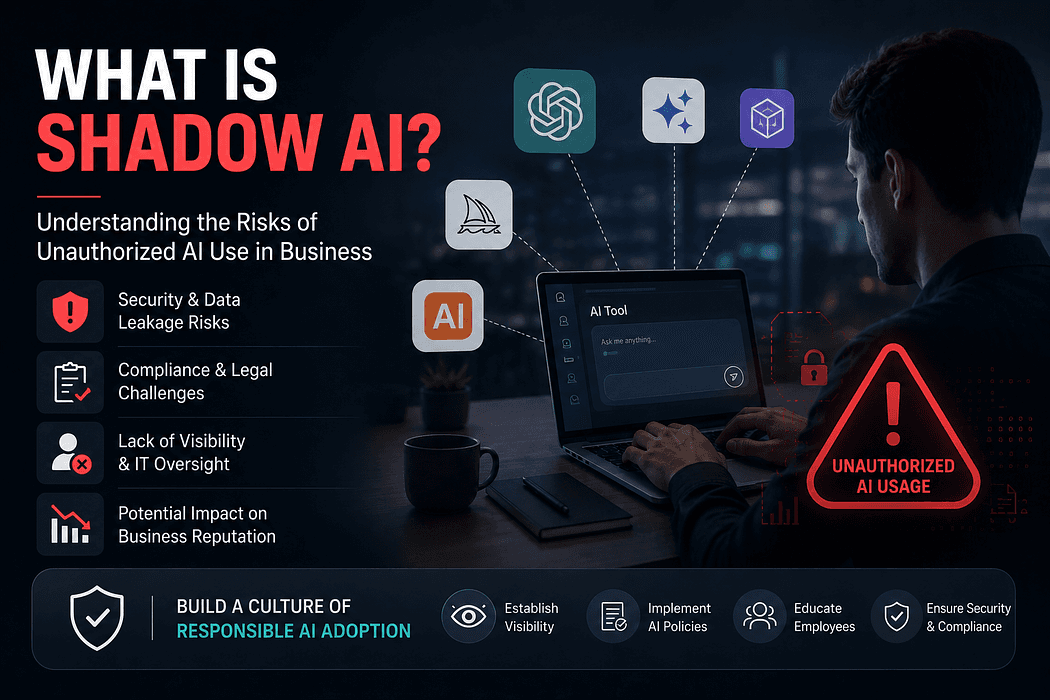
Every organization has a version of this story. A marketing associate pastes a client brief into ChatGPT to speed up a first draft. A developer runs proprietary code through a personal Copilot account to debug faster. A finance analyst uploads a spreadsheet to a free AI tool to summarize trends before a meeting. None of these employees intend harm. They simply want to work faster. But collectively, these small decisions have created one of the fastest-growing blind spots in enterprise security: Shadow AI.
Shadow AI refers to the use of artificial intelligence tools within an organization without approval or oversight from the IT department. It is the AI equivalent of Shadow IT, except the stakes are often higher, because generative AI tools ingest, process, and sometimes retain sensitive data in ways employees rarely stop to consider. Understanding what Shadow AI is, and why it is spreading so quickly, is now a prerequisite for any serious enterprise security or compliance strategy.
At its core, Shadow AI describes any AI application, plugin, browser extension, or embedded feature that employees use to perform work tasks without the knowledge or sanction of IT and security teams. This includes obvious cases, like using a public chatbot to draft an email, as well as less obvious ones, like AI features quietly embedded inside sanctioned SaaS tools that were never formally vetted.
That second category is becoming the norm rather than the exception. Industry analysis indicates that by 2026, the majority of employee interactions with AI will occur through features embedded in existing, sanctioned SaaS applications, making it harder for IT to distinguish between approved and unapproved usage. In other words, Shadow AI is no longer just about employees downloading rogue apps. It is increasingly baked into the software stack itself.
The honest answer is that these tools work, and they work well. Generative AI genuinely accelerates writing, coding, research, and analysis, and employees notice the productivity gain almost immediately. Formal approval processes, by contrast, are often slow, unclear, or nonexistent, leaving workers to make their own judgment calls.
This gap between demand and governance is visible in the numbers. Recent research shows that only a minority of organizations currently have policies in place to manage AI use or detect Shadow AI activity, even as adoption climbs. Employees are not waiting for permission because, in many cases, there is no clear policy to wait for.
The appeal of unauthorized AI tools is easy to understand. The risks, however, are substantial and often invisible until something goes wrong.
The most immediate danger is data leakage. When employees paste source code, customer records, financial data, or strategic plans into consumer-grade AI tools, that information often leaves the organization's control entirely. Analysis of GenAI usage patterns found that nearly half of generative AI users access these tools through unmanaged personal accounts, bypassing enterprise data controls. Once data is entered into a public model through a personal account, the organization typically has no visibility into how it is stored, used, or potentially exposed.
For regulated industries, Shadow AI introduces exposure that extends well beyond data loss. Healthcare, finance, and legal organizations face strict rules around data handling, and unsanctioned AI use can quietly violate them. Studies of healthcare environments found that a large share of professionals had encountered unauthorized AI tools at work, while only a small fraction understood the regulatory implications of using them. The disconnect between usage and awareness is a compliance liability waiting to surface during an audit or breach investigation.
Shadow AI is not merely a theoretical governance concern. Breach-cost research has directly linked unauthorized AI use to elevated financial exposure. One widely cited industry analysis found that Shadow AI was a factor in roughly one in five data breaches, increasing average breach costs by hundreds of thousands of dollars per incident. Security researchers also project that AI-related security incidents will continue climbing sharply through 2026, driven in part by the expanding footprint of ungoverned tools.
The next wave of Shadow AI risk is arguably more serious than the first. As AI shifts from simple chatbots to autonomous agents capable of executing multi-step tasks, unsanctioned agents introduce a new category of exposure, one where AI systems can take action on enterprise data without direct human oversight at each step. Analysts expect this agentic governance gap to widen before enterprises catch up, as adoption of embedded AI agents continues to outpace the policies built to supervise them.
Consider a software engineering team where individual developers adopt AI coding assistants through personal accounts rather than company-licensed ones. Proprietary code gets processed by external models with no contractual data protections in place, creating intellectual property exposure the organization never approved.
Or consider a customer support team using a free AI summarization tool to condense client tickets. Personally identifiable information moves through a third-party system with no data processing agreement, no audit trail, and no assurance about retention or training use. Multiply either scenario across dozens or hundreds of employees, and the scale of exposure becomes clear.
The instinct to simply ban unauthorized AI tools rarely works in practice, and prohibition-only approaches tend to push usage further underground rather than eliminating it. A more durable strategy combines visibility, sanctioned alternatives, and clear policy.
Effective AI governance typically includes the following elements.
Continuous discovery of AI tool usage across network, browser, and endpoint layers, rather than relying on periodic manual audits.
Clearly documented AI usage policies that specify which tools are approved, what data can and cannot be entered, and who to contact for new tool requests.
Enterprise-grade sanctioned alternatives that match the convenience of consumer tools, since employees are far less likely to seek out unauthorized options when a capable approved tool already exists.
Ongoing employee training, since much of the risk stems from awareness gaps rather than deliberate rule-breaking.
Cross-functional ownership involving IT, security, legal, and business unit leaders, since Shadow AI touches every part of the organization rather than a single department.
This last point matters because Shadow AI governance is not purely a technical problem. It requires aligning security controls with the practical workflows employees rely on every day.
Shadow AI is not a fringe issue or a temporary trend. It reflects a genuine gap between how quickly employees adopt useful technology and how slowly organizations formalize policy around it. The organizations managing this risk well are not the ones that ban AI outright. They are the ones building visibility into actual usage, offering sanctioned tools that meet employee needs, and setting clear expectations about data handling.
For IT and security leaders, the priority now is assessment rather than assumption. Understanding which AI tools are already in use across the organization, and why employees have gravitated toward them, is the necessary first step toward turning Shadow AI into governed, secure AI adoption.