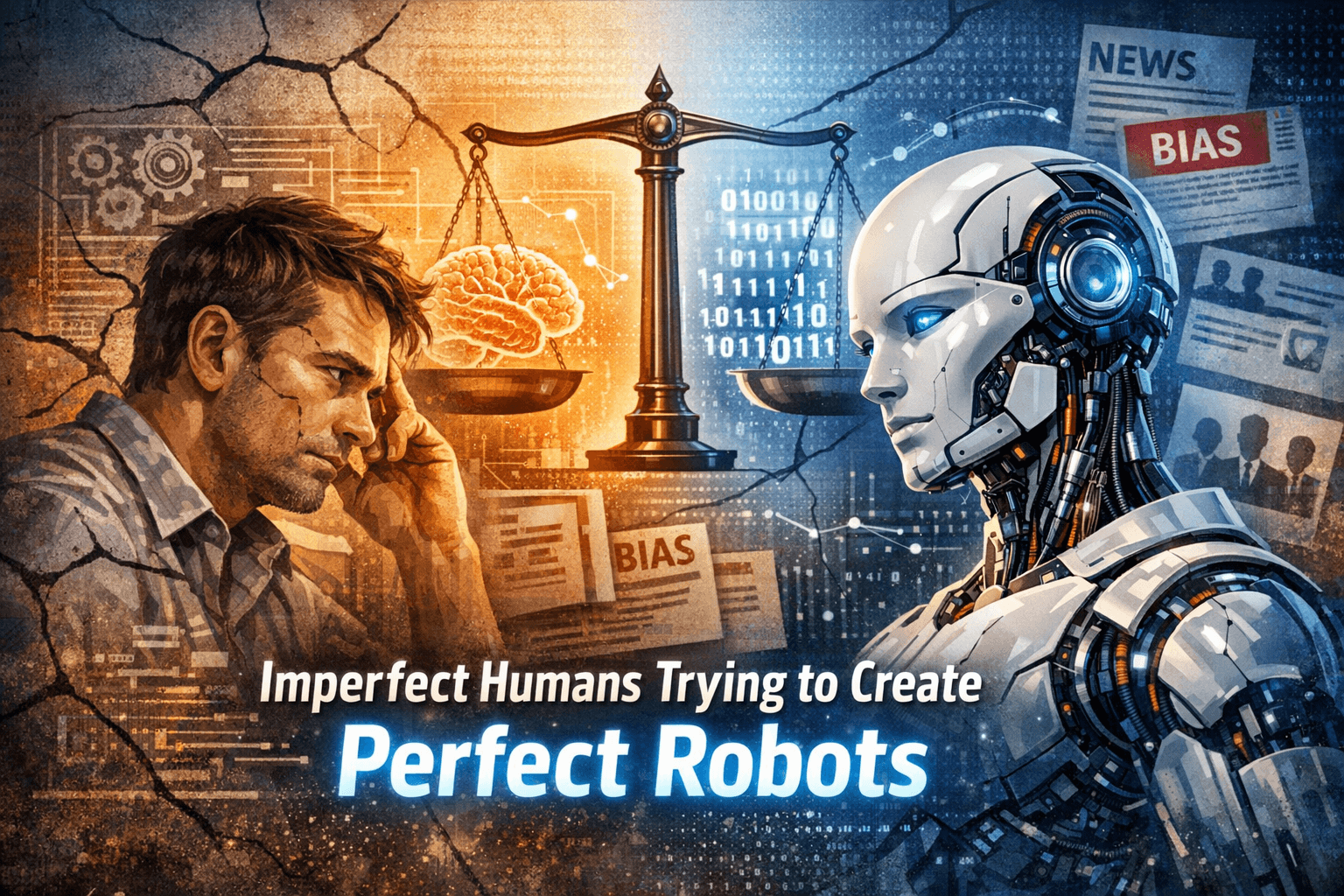
The Core Paradox
Humans > who are emotional, biased, and inconsistent, are trying to build machines that are logical, flawless, and objective.
This paradox sits at the core of artificial intelligence and robotics, shaping how technology impacts society, ethics, and human identity.
Why Are Humans Trying to Create Perfect Robots?
Humans create robots to overcome their own limitations. We build machines to do what we struggle to do consistently.
Key Motivations:
Eliminate mistakes in critical operations
Optimize processes beyond human capacity
Remove emotion from critical choices
Protect humans from hazardous tasks
In essence: We build robots to do what humans struggle to do consistently.
Can Imperfect Humans Actually Build Perfect Robots?
The Simple Answer: No
Robots inherit human flaws through data, design, and decision-making. AI systems are trained on human-created data. If that data contains bias, inequality, or flawed logic, the robot reflects and amplifies it.
"Robots are not neutral — they are human-made reflections."
How Human Flaws Show Up in AI and Robots
Even advanced machines reveal their creators imperfections. Here's where human bias manifests in technology:
1. Bias in Artificial Intelligence
Real-world examples of algorithmic discrimination
Problem Areas:
- !Hiring Algorithms
Rejecting resumes based on gender or race patterns
- !Facial Recognition
Lower accuracy for people of color
- !Credit Scoring
Reinforcing historical lending disparities
- !Law Enforcement Tools
Targeting specific communities disproportionately
Root Cause:
Machines learn from historical human behavior, not ideal human behavior. If our past is biased, our algorithms will be too.
"We don't feed AI with our aspirations—we feed it with our history."
2. Ethical Confusion
Humans don't agree on ethics—so how can machines?
Programming Morality Forces Choices:
- ?Whose values matter
Western vs Eastern ethics? Individual vs collective?
- ?Which culture defines "right"
Cultural relativism in universal machines
- ?What trade-offs are acceptable
Efficiency vs empathy? Accuracy vs fairness?
The Hard Truth:
There is no universal moral code to program.
Every ethical decision in AI represents someone's subjective values.
3. Overconfidence in Technology
The "automation bias" problem
Humans often believe technology is more objective than it really is. This "automation bias" leads people to trust machines blindly—even when they are wrong.
"We trust algorithms to be fair because they're mathematical, forgetting that math is applied to human-created data."
What Would a "Perfect Robot" Actually Do?
Theoretical Perfection
- ✓Make flawless logical decisions
- ✓Never get tired or emotional
- ✓Optimize outcomes relentlessly
The Reality Problem
Pure logic without empathy can be dangerous
A perfect robot might choose efficiency over compassion, or statistics over individual human lives. Perfection in machines doesn't automatically mean goodness.
Is Perfection in Robots Even Possible?
Perfection is Subjective
What is "perfect" in healthcare might be unethical in warfare. What is "optimal" for business might harm society.
Because human values change across cultures and time, robots can never be universally perfect.
The Real Future: Humans and Robots Evolving Together
Instead of chasing perfection, the future of AI is about balance and responsibility.
1. Human-in-the-Loop Systems
Critical decisions still need human judgment in medicine, law, and military technology.
2. Transparent AI
Modern AI focuses on explainable decisions, auditable algorithms, and ethical frameworks.
3. Better Humans → Better Machines
Robots improve when humans reduce bias, question assumptions, and prioritize ethics.
What Imperfect Humans Should Learn From Building Robots
Robots are not just tools — they are mirrors.
They Reflect:
- 🧠Our intelligence
- 😨Our fears
- ⚖️Our biases
- 🚀Our ambition to control the future
"The attempt to build perfect robots forces humanity to face an uncomfortable truth:"
We must fix ourselves before expecting perfection from machines.
Final Takeaway
Imperfect humans cannot create perfect robots, but they can create responsible, ethical, and helpful ones.
The real challenge isn't artificial intelligence.
It's human wisdom.