Executive Summary
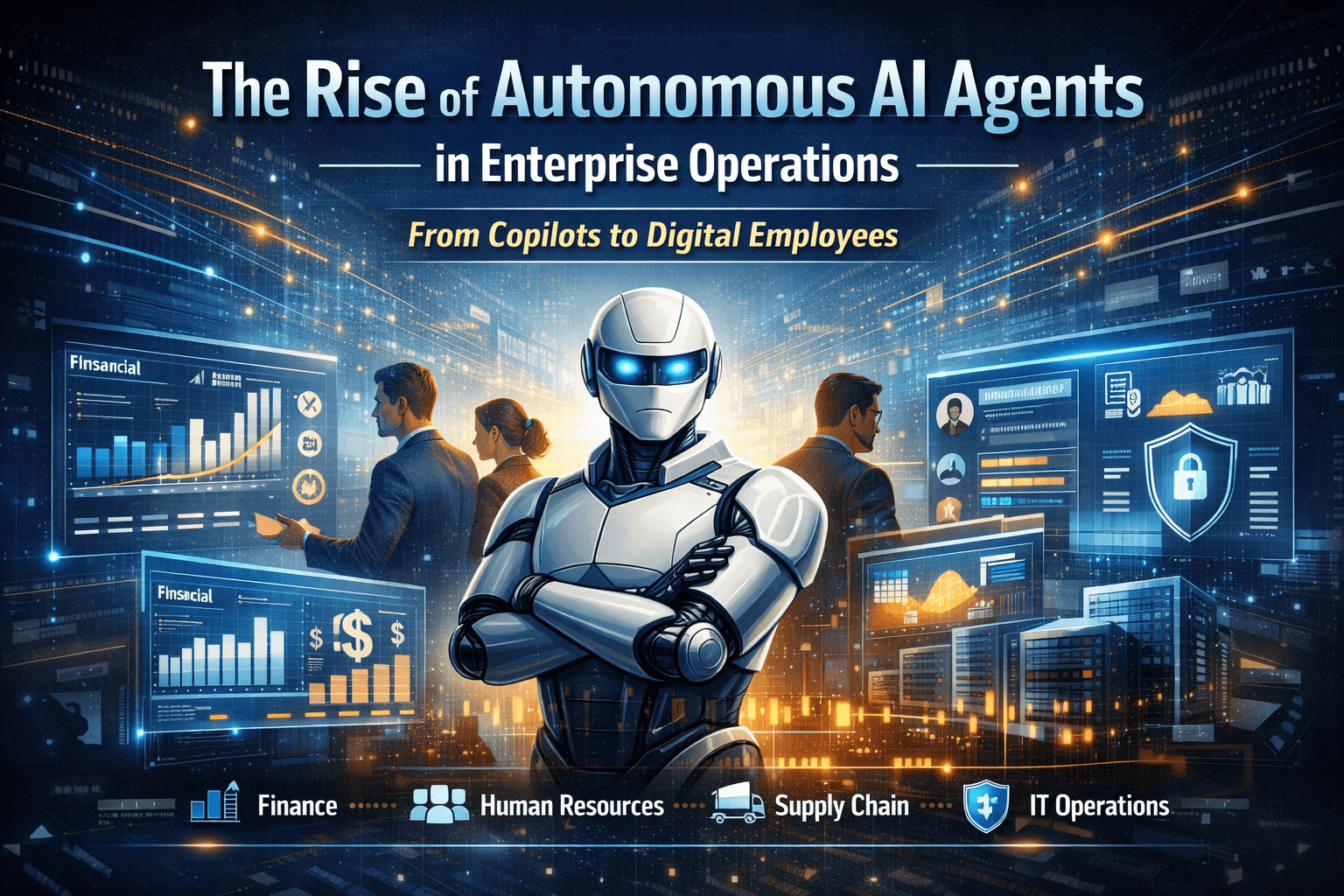
Enterprise AI is evolving from task automation to autonomous decision-making. This article explores how autonomous AI agents are becoming digital employees that reason, plan, and act independently — transforming finance, HR, supply chain, and IT operations while introducing new governance challenges.
Introduction: A Fundamental Shift in Enterprise AI
Enterprise artificial intelligence is undergoing a decisive transition. What began as task-level automation and AI copilots that assist humans is now evolving into autonomous AI agents capable of reasoning, planning, and acting independently within defined business boundaries.
These systems are not merely tools—they are becoming digital employees: software entities that execute workflows, make contextual decisions, collaborate with other systems, and continuously optimize outcomes with minimal human intervention.
For CIOs, CTOs, and enterprise leaders, this shift represents more than a technology upgrade. It signals a new operating model for the enterprise, where decision velocity, scalability, and resilience are driven by autonomous intelligence.
From Task Automation to Autonomous Decision-Making
The Copilot Era
What We Already Know
- •Assisting human users
- •Suggesting actions or insights
- •Automating repetitive micro-tasks
- •Remaining dependent on human approval
While effective, copilots are inherently reactive. They wait for instructions.
The Autonomous Agent Era
What's Emerging
- •Operate continuously in the background
- •Set goals and plan steps to achieve them
- •Integrate across multiple systems
- •Make decisions within policy constraints
- •Learn from outcomes and self-improve
This transition mirrors the shift from manual labor to knowledge workers, except now knowledge work itself is being augmented, and in some cases replaced by software intelligence.
What Exactly Is an Autonomous AI Agent?
An autonomous AI agent is a system that combines:
🧠 Perception
Ingests data from enterprise systems
💭 Reasoning
Evaluates context and objectives
📋 Planning
Breaks goals into executable steps
⚡ Action
Executes tasks via tools and APIs
📚 Learning
Adapts based on feedback and results
In practical terms: An AI agent can be assigned a role, such as:
"Optimize vendor payments for cash flow while maintaining compliance."
And then operate independently to achieve that objective.
Enterprise Functions Being Transformed by AI Agents
1. Finance: From Reporting to Financial Autonomy
AI agents are moving beyond dashboards
Key Capabilities:
- ✓Monitoring cash flow in real time
- ✓Identifying anomalous transactions
- ✓Optimizing payment schedules
- ✓Simulating financial scenarios
- ✓Enforcing compliance automatically
Impact:
Finance teams shift from manual oversight to strategic financial governance, while AI agents handle operational decisions at machine speed.
2. Human Resources: AI HR Partners
Data-intensive decisions are ideal for autonomous agents
AI Agents in HR Can:
- ✓Screen and rank candidates
- ✓Schedule interviews autonomously
- ✓Monitor employee engagement signals
- ✓Predict attrition risks
- ✓Trigger retention or training programs
Impact:
HR evolves from administrative execution to human capital strategy, supported by AI agents acting as talent operations managers.
3. Supply Chain: Self-Optimizing Operations
Real-time decision-making across volatile environments
Autonomous AI Agents Enable:
- ✓Continuous demand forecasting
- ✓Supplier risk assessment
- ✓Dynamic inventory optimization
- ✓Automated procurement decisions
- ✓Logistics rerouting during disruptions
Impact:
Supply chains become adaptive systems, capable of responding instantly to market changes without waiting for human escalation.
4. IT Operations: Autonomous Digital Infrastructure
One of the fastest adopters due to system complexity
AI Agents in IT Can:
- ✓Detect incidents before outages occur
- ✓Perform root-cause analysis
- ✓Auto-remediate issues
- ✓Optimize cloud costs
- ✓Enforce security policies continuously
Impact:
Organizations move toward self-healing infrastructure, reducing downtime and operational risk.
Digital Employees: A New Workforce Category
The concept of digital employees is rapidly gaining traction. Unlike traditional automation:
Digital Employees Have:
- •Defined roles and responsibilities
- •24/7 operational capability
- •Collaboration with humans and other agents
They Follow:
- •Governance rules and KPIs
- •Audit trails for decisions
- •Continuous improvement cycles
Examples of Digital Employee Roles
AI Financial Controller
Manages cash flow, payments, and compliance autonomously
AI Talent Screener
Evaluates candidates and manages recruitment pipelines
AI Supply Chain Planner
Optimizes inventory and logistics in real-time
AI IT Reliability Engineer
Monitors systems and auto-remediates issues
These roles are not replacing leadership—they are augmenting execution at scale.
Governance, Trust, and Risk: The Enterprise Imperative
Critical Governance Requirements
Enterprises must address these proactively
1. Decision Boundaries
Clearly define what agents can and cannot decide
2. Explainability
AI decisions must be traceable and auditable
3. Human-in-the-Loop Controls
Critical decisions require escalation or approval
4. Security & Access Control
Agents operate under least-privilege principles
5. Compliance Alignment
Regulatory standards enforced by design
Enterprises that treat governance as an afterthought risk losing trust, compliance, and control.
Why CIOs and CTOs Must Act Now
Strategic Advantages
- ✅Faster decision cycles
Real-time responses to market changes
- ✅Reduced operational costs
Automation at enterprise scale
- ✅Improved resilience
Continuous monitoring and adaptation
Strategic Risk of Delay
- ❌Slower operations
Human-dependent decision bottlenecks
- ❌Competitive disadvantage
Against AI-native enterprises
- ❌Inability to scale efficiently
Limited by human capacity
The Road Ahead: From Tools to Teammates
The next phase of enterprise transformation will not be defined by more dashboards or smarter reports—but by AI agents that operate as teammates.
In the coming years, enterprises will:
- 🤝Hire digital employees alongside humans
- 🔄Redesign workflows around autonomous agents
- 📊Measure performance across human-AI collaboration
- 💡Build organizations where intelligence is always-on
Final Thoughts
The rise of autonomous AI agents marks a turning point in enterprise operations. We are moving from AI as an assistant to AI as an active participant in decision-making.
For enterprise leaders, the question is no longer if autonomous AI will reshape operations, but how deliberately and responsibly it will be adopted.
Those who act early, with strong governance and strategic intent, will define the next generation of intelligent enterprises.