AI Evolution in Progress
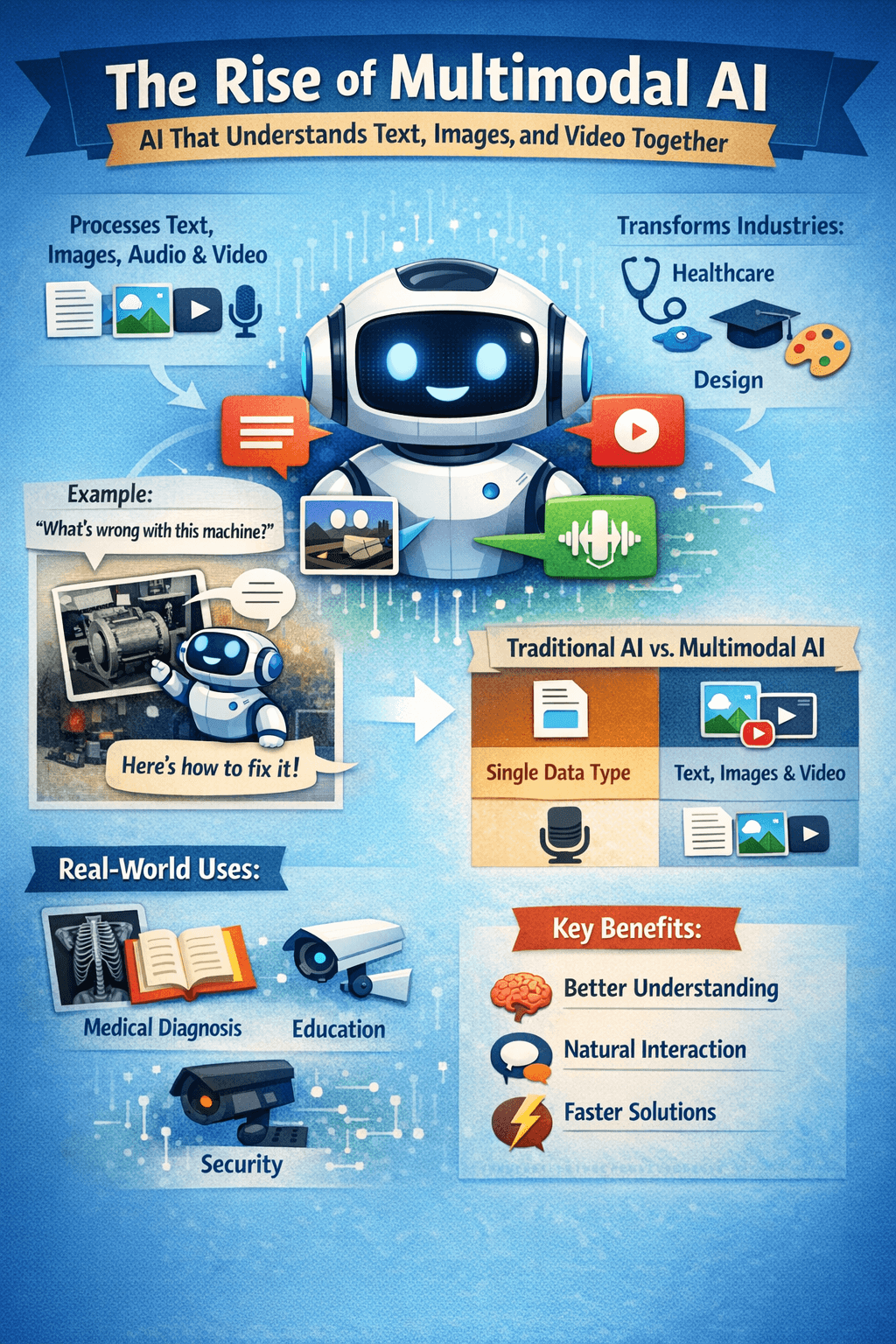
Artificial Intelligence is evolving faster than ever. One of the most significant breakthroughs is Multimodal AI — systems that can understand text, images, audio, and video simultaneously.
This transformation is revolutionizing industries from healthcare and design to education and security.
What Is Multimodal AI?
Multimodal AI refers to artificial intelligence systems that can process and combine multiple types of data simultaneously. Unlike traditional single-mode AI, multimodal systems understand the relationships between different data formats.
Key Capabilities:
Reads and comprehends written content, documents, and conversations
Recognizes objects, patterns, and context in visual data
Analyzes motion, actions, and temporal sequences
Understands speech, tones, and environmental sounds
Simple Example:
You upload a photo of a broken machine and ask:
"What's wrong with this and how can I fix it?"
A multimodal AI can see the image, understand your question, and provide step-by-step repair instructions.
How Multimodal AI Works (In Simple Terms)
Multimodal AI uses advanced machine learning models trained on diverse data types:
Training Data Types:
- 📚Text Data: Articles, books, conversations
- 🖼️Image Data: Photos, diagrams, medical scans
- 🎬Video Data: Motion patterns, events, actions
- 🔊Audio Data: Speech, environmental sounds
The Learning Process:
The AI learns how different data types relate to each other, creating a unified understanding of context.
Example Models: GPT-4 with Vision, CLIP, Flamingo
Why Multimodal AI Is Revolutionary
Breaking Traditional Limits
Old AI systems worked in isolation
Traditional AI:
- ✗Isolated Systems
Text AI couldn't see images
- ✗Limited Context
No cross-modality understanding
- ✗Manual Integration
Humans had to connect different outputs
Multimodal AI:
- ✓Unified Intelligence
Single system understands everything
- ✓Context-Aware
Connects text with visual context
- ✓Natural Interaction
Communicates like humans do
Key Benefits:
Better Understanding
Natural Interaction
Higher Accuracy
Faster Solutions
Real-World Applications of Multimodal AI
1. Design & Creativity
Transforming creative workflows
What Designers Can Do:
- →Upload sketches or mood boards
AI generates complete designs
- →Describe concepts in words
Get visual interpretations
- →Iterate designs instantly
Rapid prototyping with AI feedback
Impact:
70% Faster
Design iteration speed
Enhanced Creativity
AI suggests novel combinations
2. Healthcare & Medical Diagnostics
Life-saving applications
Medical Applications:
- +Upload X-rays, MRIs, CT scans
AI analyzes visual medical data
- +Add patient symptoms & history
Text data for comprehensive analysis
- +AI-assisted diagnosis
Cross-references symptoms with scans
Key Benefits:
Early Detection: Identifies patterns humans might miss
Reduced Errors: Cross-modal verification
Personalized Care: Tailored treatment recommendations
3. Education & Learning
Personalized educational experiences
Student Capabilities:
- 📸Photo of homework problems
AI recognizes and solves math equations
- 🎤Ask questions verbally
Speech-to-text with visual explanations
- 📊Interactive diagrams & charts
Visual learning with text explanations
Educational Impact:
"Makes learning accessible to different learning styles"
95%
Engagement Increase
40%
Faster Learning
Adaptive
Personalized Paths
4. Security & Surveillance
Enhanced safety systems
Security Applications:
- 👁️Real-time video monitoring
Analyzes behavior patterns
- 🔊Audio anomaly detection
Gunshots, screams, glass breaking
- 📝Text-based threat analysis
Combines with visual data
Advantages:
Fewer false alarms
Faster response times
Comprehensive threat assessment
Multimodal AI vs Traditional AI
| Feature | Traditional AI | Multimodal AI |
|---|---|---|
| Data Types | ✗Single (text OR image) | ✓Multiple (text, image, video) |
| Understanding | ✗Limited | ✓Context-Aware |
| Interaction | ✗Basic | ✓Natural & Human-like |
| Accuracy | ✗Moderate | ✓High |
| Learning | ✗Specialized | ✓Holistic |
| Applications | ✗Narrow | ✓Broad & Flexible |
Challenges of Multimodal AI
Important Considerations
Technical Challenges:
- 💻High Computing Costs
Processing multiple data types requires significant resources
- 🛡️Data Privacy Concerns
Handling sensitive information across modalities
Ethical Challenges:
- ⚖️Bias in Training Data
AI can inherit human biases from training data
- 🤝Responsible AI Development
Need for ethical frameworks and governance
Developers and organizations must address these challenges for safe, ethical AI adoption
The Future of Multimodal AI
Multimodal AI is still evolving, but the trajectory is clear and exciting
Smarter Assistants
Virtual assistants that understand context naturally
Advanced Diagnostics
AI doctors analyzing symptoms with medical images
Human-AI Collaboration
Seamless teamwork between humans and AI systems
Human-Like Understanding
AI that perceives the world like humans do
Final Thoughts
The rise of multimodal AI represents a quantum leap in artificial intelligence. By understanding text, images, and video together, AI systems are becoming more useful, intuitive, and powerful.
From creative design to life-saving medical applications
Multimodal AI is shaping our future
And this transformation is only just beginning.